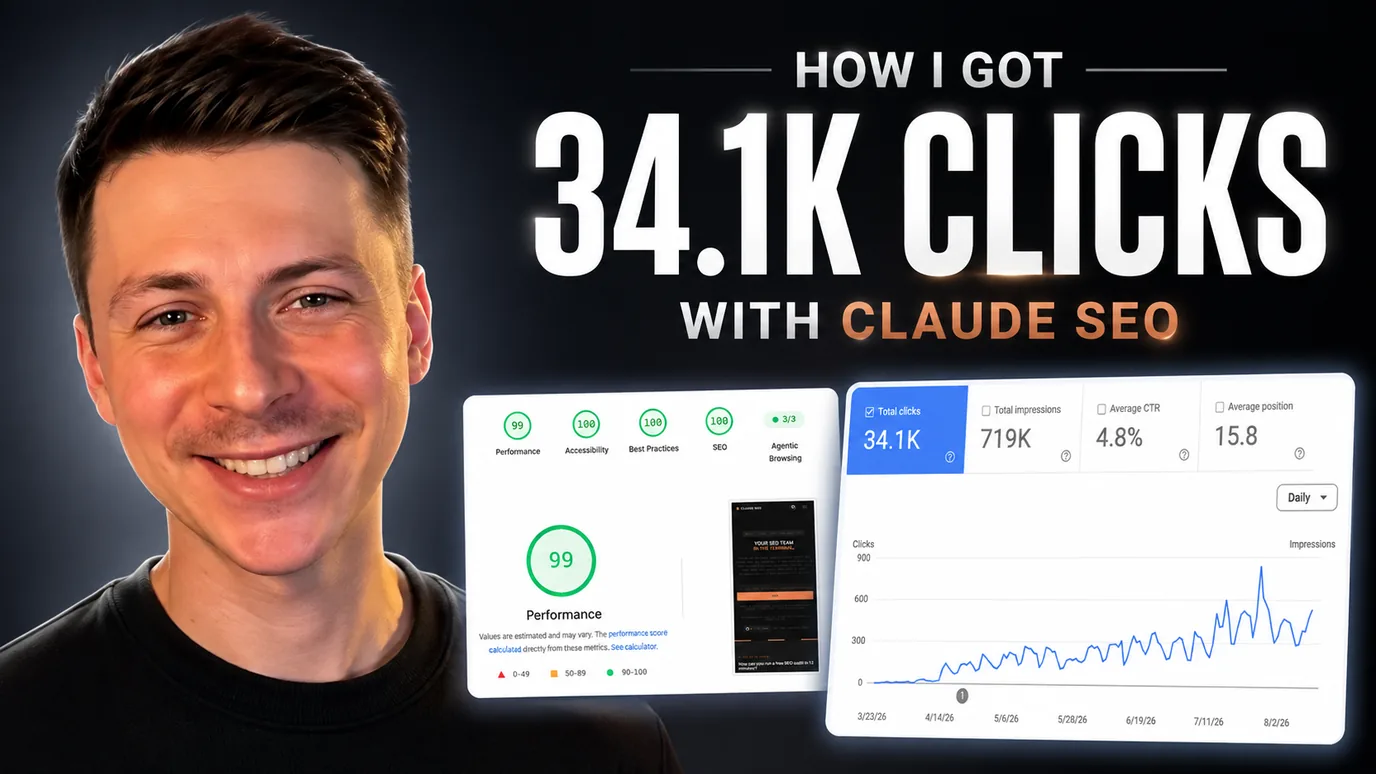
In June 2026 this site had roughly 11,000 organic clicks. It now has 34,100. That happened in one month, on a documentation site for a tool that is given away for free, with no advertising spend and no purchased backlinks.
This post is the written version of the checkpoint. It shows the four Google Search Console numbers, explains which of them is genuinely good and which one is not, describes how the site was built with Claude SEO and Claude Blog, and states plainly what the tool does not do.
Key takeaways
- Search Console records 34,100 clicks and 719,000 impressions at a 4.8% average CTR for the reporting window shown in the August 2026 walkthrough.
- Daily clicks roughly doubled, from about 250 per day to about 500 per day.
- Average position 15.8 is the weak number. The site collects impressions it does not convert, because a large share of queries rank on page two.
- The work was done with a free, MIT licensed Claude Code skill, not an agency retainer or a commercial subscription.
- Claude SEO does not replace a deep enterprise crawl and has no backlink index of its own.
What do the Search Console numbers actually say?
Four numbers describe the current state of the site. They come from the Google Search Console performance report captured on screen in the video walkthrough published on August 26, 2026. The daily curve in that report runs from late March 2026 to early August 2026.
Clicks and impressions are the headline. A 4.8% average click-through rate across 719,000 impressions is a healthy rate for a mixed set of informational and branded queries. The growth pattern in the daily chart is also the right shape: it starts near 100 clicks per day, climbs through the 200 to 400 band, and settles above 500 on the strongest days.
The comparison against the previous checkpoint makes the size of the change clearer.
Daily volume moved in step with the total. The site was serving roughly 250 clicks per day at the previous checkpoint and is now serving roughly 500 per day. For a documentation site with no advertising behind it, that is the compounding effect of technical fixes and published content arriving at the same time.
Watch the full Search Console walkthrough
The video below is the eight minute version of this post. It steps through the live Search Console report, the growth curve, the position problem, and a live audit run in the terminal.
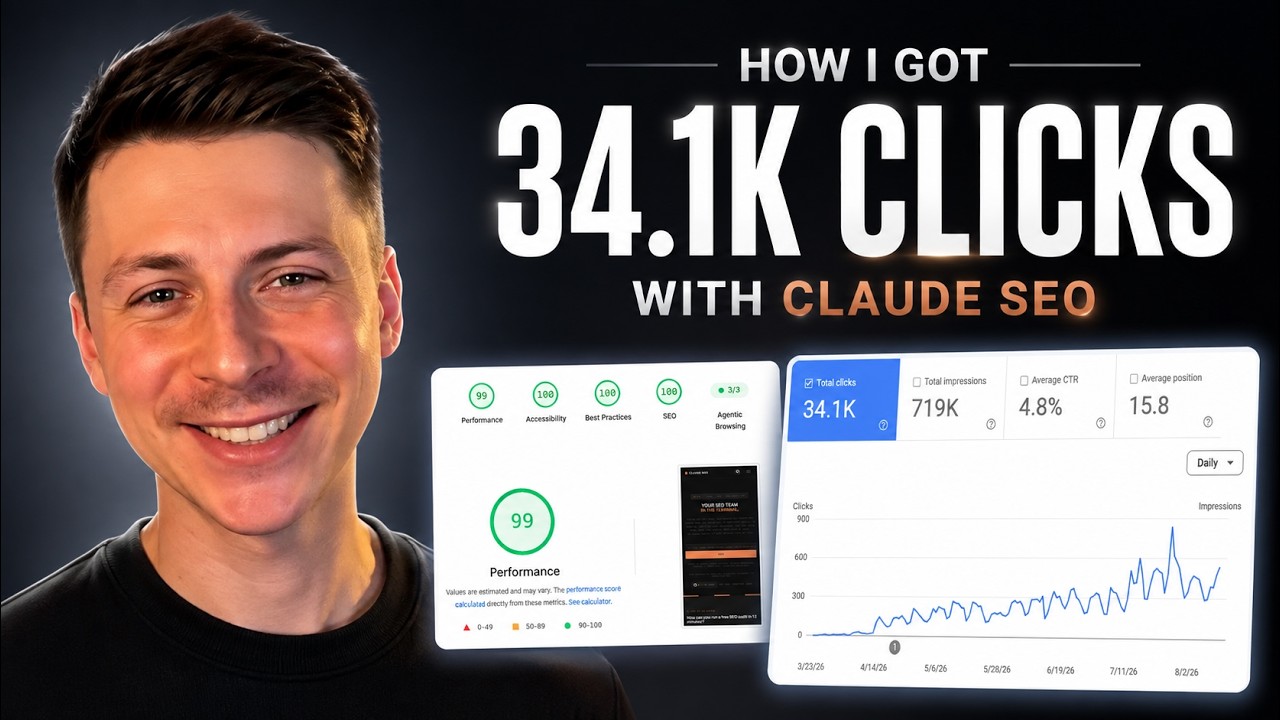
This Claude Code skill got me 34,000 organic clicks (zero ads). Published August 26, 2026. Runtime 8:02. Watch on YouTube. The previous checkpoint is the 11,000 click walkthrough.
How was the site built?
The site is a static HTML project with no framework and no build step. Two open-source skills did the work that would normally be split between an SEO consultant and a content team.
Claude SEO handled the technical layer: crawlability, indexability, structured data, internal linking, image handling, sitemap hygiene, and the generative engine optimization work that decides whether an AI answer engine can quote a page. Claude Blog handled the article production that fills the blog index. A design pass sits on top of both.
The tooling itself is public. As checked on August 26, 2026, the Claude SEO repository reports 15,113 stars and 2,215 forks, and the current release is v2.2.5. The skill ships 25 sub-skills, 18 specialist agents with up to 15 running concurrently during an applicable audit, 32 user-invocable commands, and 8 optional data extensions.
None of that matters on its own. What matters is that a single command produces a scored, prioritized action plan instead of a 200-row spreadsheet that nobody reads. For the mechanics of that workflow, see how to run a free SEO audit with Claude SEO and the technical SEO walkthrough.
The number I am not happy with
Average position 15.8 is the weak result in this report, and it is the reason the other numbers are lower than they should be. An average of 15.8 means a large share of ranking queries sit on the second page of results.
The consequence is visible in the same report. The site accumulated 719,000 impressions and converted 34,100 of them. Those impressions already exist. They are being served today, at a position where most users never scroll far enough to see the result. Moving the average into the 7 to 8 range would convert a much larger share of that same impression pool, without ranking for a single new keyword.
The honest read: click growth of this size is easy to present as a finished result. It is not. A site averaging position 15.8 has a conversion problem between impression and click, not a discovery problem. That gap is the next body of work, not a footnote.
The fixes for that gap are different from the fixes that produced this growth. Position work means matching page type to search intent, tightening title and meta pairs against real query data, consolidating pages that split the same intent, and strengthening the internal link paths into the pages that deserve to rank higher. The search experience optimization skill and topic clustering by SERP overlap both target exactly this problem.
What does this work normally cost?
The reason this case study exists is the price gap. A manual technical audit of a site this size is commonly a four to eight hour job. Agencies quote engagements in the low thousands and up. Commercial platforms run on monthly subscriptions.
Those ranges are market observations, not a benchmark study, and a good agency earns its fee on strategy that no skill replaces. The relevant point is narrower: the specific job of finding what is technically broken on your own site should not be the part you pay thousands of dollars and wait weeks for. A side-by-side breakdown lives in Claude SEO versus Ahrefs and Semrush.
What Claude SEO does not do
Two limits are worth stating directly, because tools in this category routinely overclaim.
- It is not a replacement for a deep crawler. Screaming Frog and comparable crawlers do exhaustive enterprise crawls at a scale and depth Claude SEO does not attempt.
- It has no backlink index of its own. Building a web-scale link graph takes infrastructure that an open-source skill does not have.
Instead of pretending otherwise, the skill connects to the providers that do own that data. DataForSEO, Ahrefs, SE Ranking, and Bing Webmaster Tools plug in through documented extensions, so backlink and SERP data comes from a real index under your own account and billing. The backlinks skill documents which sources are free and which require a key.
One more caveat on the screenshots in the video. The 99 Lighthouse performance score visible next to the Search Console panel is a lab measurement. It is not a Core Web Vitals field result and does not establish a Core Web Vitals pass, which requires field LCP, INP, and CLS data. The archived benchmark and that distinction are documented on the speed report page.
How to run the same audit on your site
The install is one command, and the first audit needs nothing beyond a URL.
git clone --depth 1 https://github.com/AgriciDaniel/claude-seo.git && bash claude-seo/install.sh
Then, inside Claude Code:
/seo audit example.com
The agent crawls the site, runs the applicable specialists in parallel, and returns a scored plan ordered by impact. Work the list, run it again, and keep going until the technical layer stops producing findings. The full installation paths, including Windows and the managed runtime, are on the install page.
The skill is not limited to Claude. The same audit runs through other coding agents, and a Codex port is maintained separately. Once the technical layer is clean, content is the next constraint, which is where the GEO guide and Claude Blog take over.
Order of operations: fix technical issues first, then publish content. Publishing into a site that search engines cannot crawl, render, or parse is how good articles disappear. This site did the first part before it did the second.
What happens next
The next checkpoint is about position, not clicks. The target is moving average position from 15.8 toward the 7 to 8 range and converting more of the 719,000 impressions the site already earns. That is a slower and less photogenic kind of progress than tripling a click count, and it is the more valuable one.
Thanks to the 2,215 people who forked the project and the contributors whose fixes shipped in v2.2.4. The tool is free because the feedback loop that improves it is worth more than a license fee.