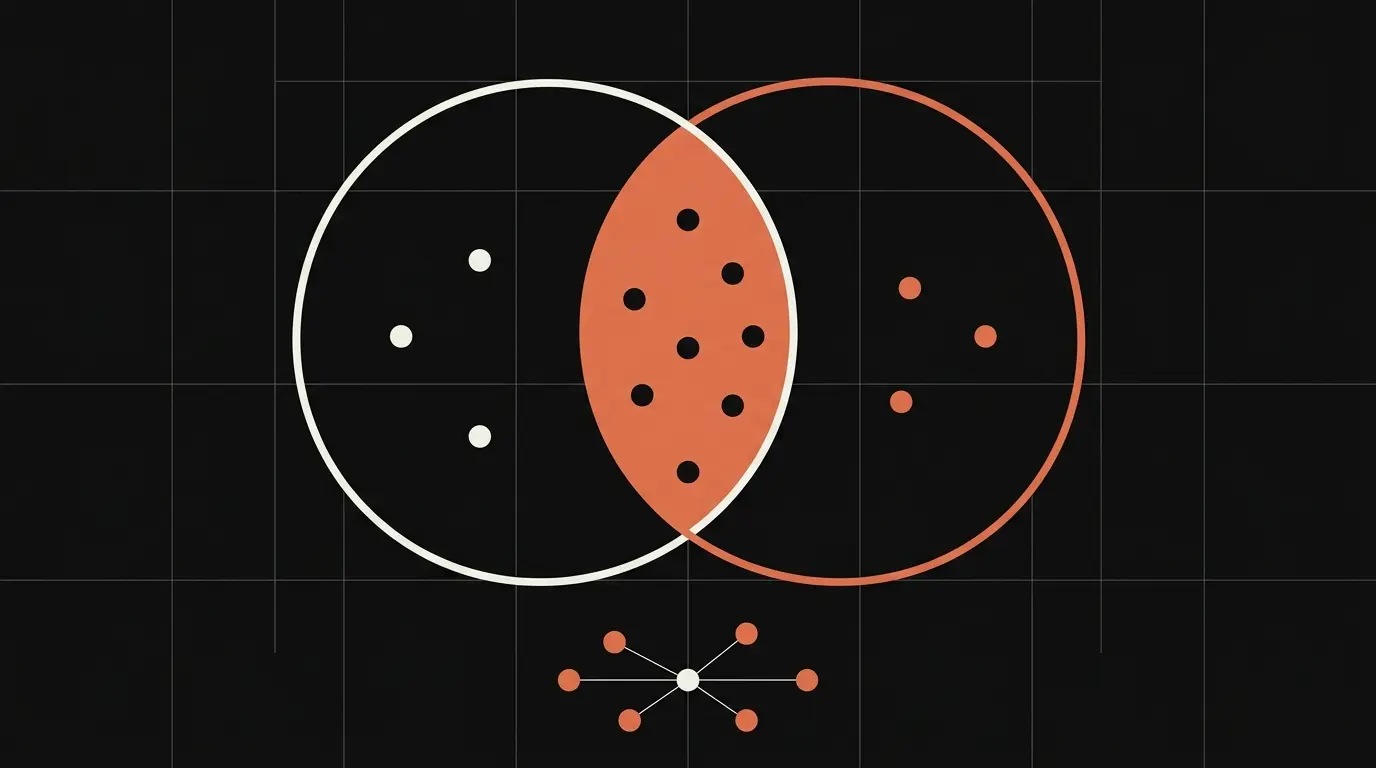
- SERP overlap clustering is a method that compares the result URLs returned for two keywords at a recorded time and location.
- Claude SEO uses default review bands: 7 to 10 shared results suggests a merge review, 4 to 6 suggests a shared cluster, and lower overlap suggests separation or cross-linking. These are heuristics, not Google thresholds.
- Hub-and-spoke architecture with mandatory bidirectional links, 2 to 3 lateral spoke-to-spoke links per post, no orphans, no cannibalization.
- Intent classification per cluster drives template choice: ultimate-guide, how-to, listicle, comparison, review, best-of, landing-page.
- Outputs:
cluster-plan.json, human-readable plan, interactivecluster-map.htmlsized by volume, plus content briefs or direct execution via claude-blog.
Text similarity and SERP overlap answer different questions. Text similarity compares language. SERP overlap compares the URLs present in a search-results snapshot. The seo-cluster skill uses overlap as one practical input, then asks the reviewer to inspect intent and page scope.
The text-similarity trap
Walk through a hypothetical example. Suppose a text-similarity model assigns "best running shoes" and "top running sneakers" a 60 percent score. Different enough to need separate pages? Or similar enough to merge? The model output cannot answer that publishing question by itself.
In a hypothetical snapshot where the queries share 8 of 10 organic results, the overlap is 80 percent under the skill's shared-result calculation. That is strong evidence that the current result sets are similar, so one page should be considered before two pages are commissioned. It is not proof that Google assigns a permanent intent label or that one page will rank for both queries.
The inverse can also happen. If a recorded snapshot for "marketing automation" and "marketing automation software" shares only 2 organic URLs, review the result types before merging the keywords. One result set may lean informational and the other commercial. The snapshot is evidence for a manual intent decision, not a timeless classification.
Neither method predicts ranking outcomes on its own. Language similarity is useful for topical organization, while overlap adds evidence about the pages surfaced for a specific locale, device, date, and query set. Claude SEO records those assumptions and treats borderline groups as review items.
What does SERP overlap measure?
Claude SEO counts shared unique URLs in two organic top-10 result sets and divides by the comparison depth. Seven shared URLs therefore produces a 70 percent shared-result ratio. This is not the formal Jaccard index, which divides by the union of both sets. The default bands below are workflow heuristics and should be checked against the actual pages and search intent.
| Shared top-10 URLs | Default review band | Suggested next step |
|---|---|---|
| 7 to 10 | Possible same-page intent | Review a merge before creating another page |
| 4 to 6 | Related result sets | Review within the same topic cluster |
| 2 to 3 | Weak adjacency | Inspect intent before cross-linking |
| 0 to 1 | Little observed overlap | Usually separate, but verify the snapshot |
The default calculation ignores ads, featured snippets, and People Also Ask, then compares only the organic top 10. This keeps the input consistent, but it also means the output does not describe every search feature or every way a user can discover a page.
From cluster to architecture
Clusters on their own are just lists of keywords. They become useful when they turn into pages. The seo-cluster skill outputs a full architecture:
- Hub pages: one broad pillar proposal per cluster, with scope based on the topic rather than a required word count.
- Spoke pages: focused supporting-page proposals selected from distinct subtopics and observed intent.
- Internal link matrix: hub-to-spoke and spoke-to-hub mandatory, 2 to 3 spoke-to-spoke within cluster, 0 to 1 cross-cluster, anchor text suggested per link.
- Intent classification per cluster (informational, commercial, transactional, navigational) drives template choice.
- Interactive
cluster-map.htmlsized by total search volume, expandable per cluster.
The architecture is the output. The keywords are just raw material.
How is search intent classified?
SERP composition can inform an intent hypothesis. Review the dominant page types, titles, and features in a dated snapshot, then validate the classification against the query and audience.
- Informational: SERPs filled with articles, guides, how-tos. Template: ultimate-guide, how-to, explainer, listicle.
- Commercial: SERPs filled with comparison pages, reviews, listicles like "best X for Y". Template: comparison, review, best-of.
- Transactional: SERPs filled with product pages, pricing, buy CTAs. Template: landing-page.
- Navigational: SERPs filled with a single brand's properties. Excluded from clusters.
Each cluster gets one primary intent and 0 to 2 secondary intents. URL pattern and template follow the intent assignment. The skill flags borderline cases like "best CRM software" (commercial dominant, informational secondary) for manual review rather than guessing.
How does hub-and-spoke link math work?
A hub page can help users and crawlers discover related spokes, while relevant spoke links return readers to the broader topic. Internal links also participate in PageRank flow, but the value of a link depends on context, crawlability, and the usefulness of the destination.
Cluster architecture fixes that. Every spoke must have at least 3 incoming internal links. No orphan pages (every post reachable from pillar in 2 clicks). Anchor text uses the target keyword or a close variant, never "click here". Link placement sits inside body content, not just navigation and sidebar.
A cannibalization review runs before pages are proposed. High overlap and duplicate primary targets are flagged, but the tool cannot prove that two pages compete or guarantee that every conflict is caught. Review current queries, rankings, canonicals, and page purpose before merging URLs.
The link plan is not a ranking guarantee. Its immediate benefits are clearer navigation, fewer orphan pages, and explicit relationships between a broad resource and its supporting detail. Measure search and user outcomes after publication instead of assuming the architecture caused an improvement.
Execution: brief vs build
After /seo cluster <seed-keyword> generates an architecture, two paths exist.
Editorial brief (default). Outputs a JSON plan plus a markdown brief listing the hub and spokes, suggested URLs, target keyword and secondaries per page, template type, word count, and the internal links each page needs to receive and emit. Hand it to a writer or to claude-blog.
Direct execution. If claude-blog is installed, /seo cluster execute hands the plan off and claude-blog writes the pillar plus spokes with the agreed link matrix automatically. Pillar first, then spokes by volume highest first. After each post, previous posts get scanned for backward link placeholders and the new URL gets injected. The result is a fully linked cluster with every spoke reachable from the hub, not a stack of orphaned posts nobody can navigate.
/seo cluster running shoes
/seo cluster execute
Community contribution
The cluster skill was contributed by Lutfiya Miller as the Pro Hub Challenge winner. The current Claude SEO contributor record preserves that attribution. It was integrated into Claude SEO v1.9.0 with permission and continues to ship in current releases.
Pair with the rest of Claude SEO
The cluster skill is one node in a graph of skills that compose into a real workflow.
- /seo plan and FLOW find for keyword discovery, then cluster turns discoveries into architecture.
- /seo programmatic for cluster plus variant pages at scale (city, industry, use-case grids).
- /seo dataforseo for provider-backed SERP snapshots when DataForSEO credentials are configured. Provider pricing and limits apply.
- /seo content for E-E-A-T quality on each spoke after it is written.
Start now
Step by step.
- Install Claude SEO.
- Pick a seed keyword. Start broad: "running shoes", "remote work", "ecommerce platforms".
- Run
/seo cluster <seed-keyword>. - Open the resulting
cluster-map.htmlin a browser. Explore the clusters, check the link relationships, sanity-check the pillar choice. - Hand the brief to a writer, or run
/seo cluster executeif you have claude-blog installed.
claude /install github:AgriciDaniel/claude-seo
/seo cluster running shoes
Conclusion
SERP overlap adds observable search-result evidence to a clustering decision, while text similarity adds linguistic evidence. High overlap is a reason to review whether one page can satisfy both queries. Low overlap is a reason to inspect whether the intents or result types differ. Neither signal should make the publishing decision alone.
Build the architecture from recorded evidence, then validate the proposed pages and links with human review. The skill is free, MIT licensed, and ships with Claude SEO. One seed keyword produces an inspectable plan and interactive cluster map, not a promise of rankings.