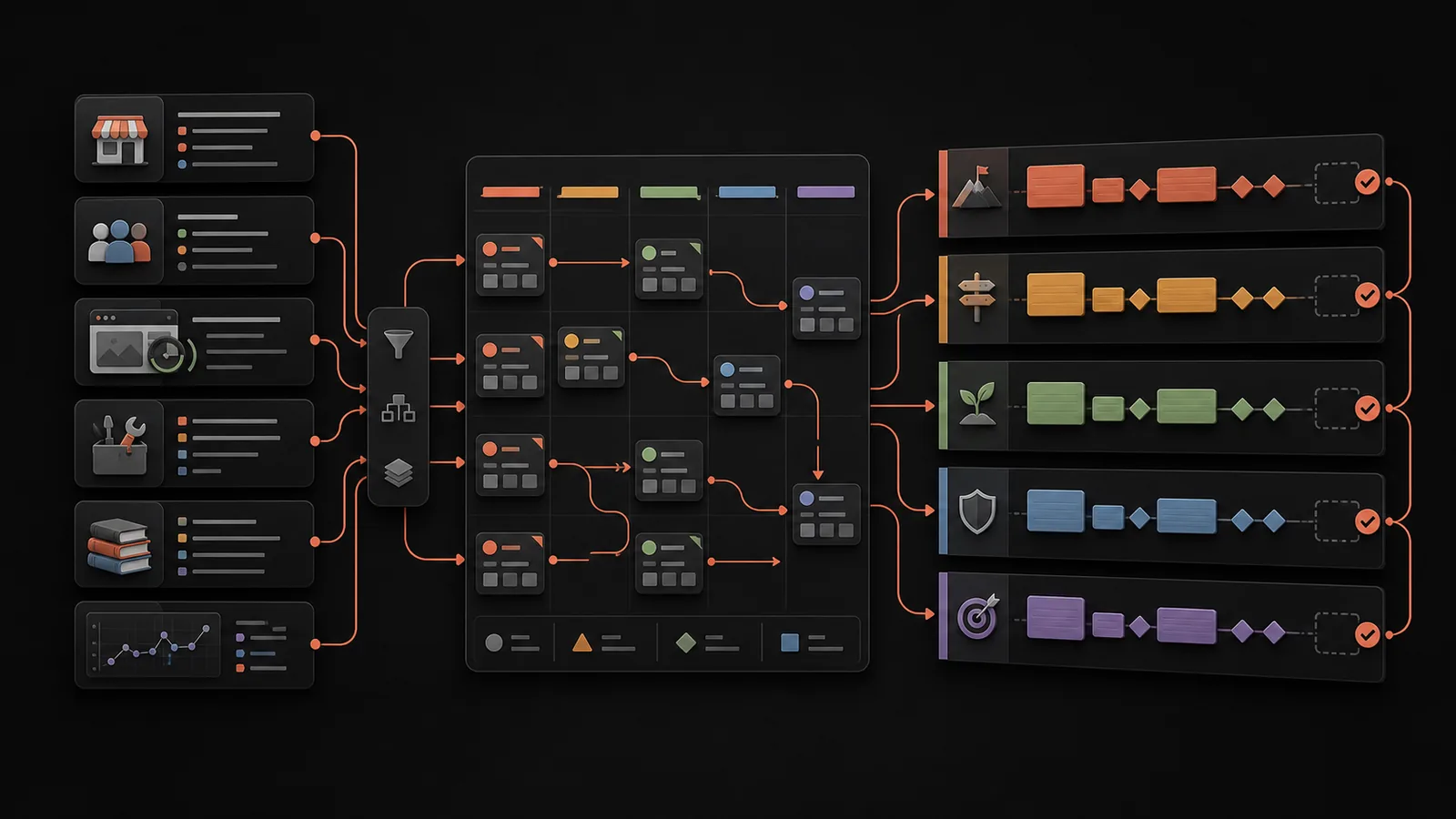
An SEO plan is a prioritized strategy for improving a site's search visibility through technical, content, architecture, and authority work. Claude SEO builds plans for new or existing sites with industry templates, competitor analysis, content calendars, site structure, and a phased implementation roadmap.
The planner creates editable local artifacts. Live competitor evidence appears only when site context and provider data are available.
OUTCOME
Five editable strategy artifacts, including a roadmap template that still needs business owners and decisions.
REQUIRED INPUT
A supported business type supplied to /seo plan <business-type>, plus goals and optional site context.
READINESS
Bring verified business facts, constraints, and goals. DataForSEO is optional for paid live competitor and keyword enrichment.
LOCAL OUTPUT
SEO-STRATEGY.md, COMPETITOR-ANALYSIS.md, CONTENT-CALENDAR.md, IMPLEMENTATION-ROADMAP.md, and SITE-STRUCTURE.md.
SIDE EFFECTS
Writes local planning files and can make approved provider requests. It does not execute the roadmap or edit a live site.
COST + APPROVAL
Estimate and approve paid enrichment. Human owners must tailor and approve timing, budgets, KPIs, dependencies, and execution.
// HOW IT WORKS
What does an SEO plan include?
When you run /seo plan, Claude SEO walks through a 6-step strategic planning process: discovery, competitive analysis, architecture design, content strategy, technical foundation, and implementation roadmap. Each step produces actionable deliverables tailored to your business type.
The planner loads industry-specific templates that adapt URL hierarchy, content strategy, schema recommendations, and KPI targets. When a site URL and live evidence are available, it can compare selected competitors for content gaps and observable trust signals. New-site mode records that live site and competitive-gap checks were skipped.
What each planning step covers
The 6-step process produces a complete SEO strategy. Each step builds on the previous one, so the final roadmap reflects your specific business type, competitive landscape, and goals.
01
DISCOVERY
Business type, target audience, competitors, goals. Current site assessment (if exists). Budget and timeline constraints. Key performance indicators (KPIs) defined upfront.
02
COMPETITIVE ANALYSIS
When live URL and provider data are available, select relevant competitors and compare content, schema, technical setup, keyword gaps, and observable trust signals. New-site mode omits unsupported gap findings.
03
ARCHITECTURE DESIGN
Load industry template. Design URL hierarchy and content pillars. Plan internal linking strategy. Sitemap structure with quality gates. Information architecture for user journeys.
04
CONTENT STRATEGY
Content gaps vs competitors. Page types and estimated counts. Blog and resource topics with publishing cadence. E-E-A-T building plan with author bios, credentials, and experience signals.
05
TECHNICAL FOUNDATION
Hosting and performance requirements. Schema markup plan per page type. Core Web Vitals baseline targets. AI search readiness requirements. Mobile-first considerations.
06
IMPLEMENTATION ROADMAP
Editable four-phase, 12-month starting template: Foundation, Expansion, Scale, and Authority. Tailor and approve timing, resources, dependencies, and targets before use.
TEMPLATES
6 INDUSTRY TEMPLATES
SaaS/software companies, local service businesses, e-commerce stores, content publishers/media, agencies and consultancies, and a generic business template. Each adapts recommendations to the industry.
KPI TRACKING
MEASURABLE TARGETS
Draft measurement points for organic traffic, rankings, authority indicators, indexed pages, and Core Web Vitals. A human must choose suitable baselines, targets, owners, and review intervals.
OPTIONAL
DATAFORSEO INTEGRATION
Can add live competitor, traffic, keyword, and local-business data. Requires the user's DataForSEO credentials, consumes paid credits, and should run only after a cost estimate and confirmation.
// ROADMAP
How does phased implementation work?
The implementation roadmap starts with an editable four-phase, 12-month template. Its timing, resources, dependencies, targets, and risks must be tailored to the business and approved. It is not a traffic or delivery forecast.
Replace "saas" with your business type: saas, local-service, ecommerce, publisher, agency, or generic. Claude SEO loads the matching industry template and generates five editable planning files.
Output files
SEO-STRATEGY.md - complete strategic plan with goals, target audience, and approach
COMPETITOR-ANALYSIS.md - evidence-backed comparisons when live URL and competitor data are available, with skipped checks labeled in new-site mode
CONTENT-CALENDAR.md - content roadmap with publishing cadence and topic priorities
IMPLEMENTATION-ROADMAP.md - 4-phase action plan with timelines and dependencies
SITE-STRUCTURE.md - URL hierarchy and information architecture
Once a page priority is approved, hand it to the SEO content brief workflow for query-level research, evidence needs, an outline, and internal-link suggestions.
// FAQ
QUESTIONS ABOUT SEO PLANNING
The planner creates five editable deliverables: SEO-STRATEGY.md, COMPETITOR-ANALYSIS.md, CONTENT-CALENDAR.md, IMPLEMENTATION-ROADMAP.md, and SITE-STRUCTURE.md. Live competitor-gap findings require a site URL and available evidence; new-site mode records that those checks were skipped.
Claude SEO includes 6 industry-specific templates: SaaS/software companies, local service businesses, e-commerce stores, content publishers/media, agencies and consultancies, and a generic business template. Each template adapts URL hierarchy, content strategy, schema recommendations, and KPI targets to the specific industry.
The default roadmap is a four-phase, 12-month starting template covering foundation, expansion, scale, and authority work. Its timing, resources, dependencies, and KPI targets must be tailored and approved; it is not a traffic or delivery forecast.
Yes, optionally. DataForSEO can add live competitor, traffic, keyword, and local-business data. Those calls require the user's credentials, consume paid credits, and should run only after a cost estimate and confirmation. Core planning works without DataForSEO.
Claude SEO's code is open-source under the MIT license. Running the planner still requires Claude Code or model access under the user's plan. Optional DataForSEO calls have separate paid usage; the skill itself does not include a paid feature tier.
// RELATED SKILLS
EXPLORE MORE
FULL SITE AUDIT
The full-site audit delegates to up to 17 specialists and combines 7 weighted categories in one prioritized action plan.