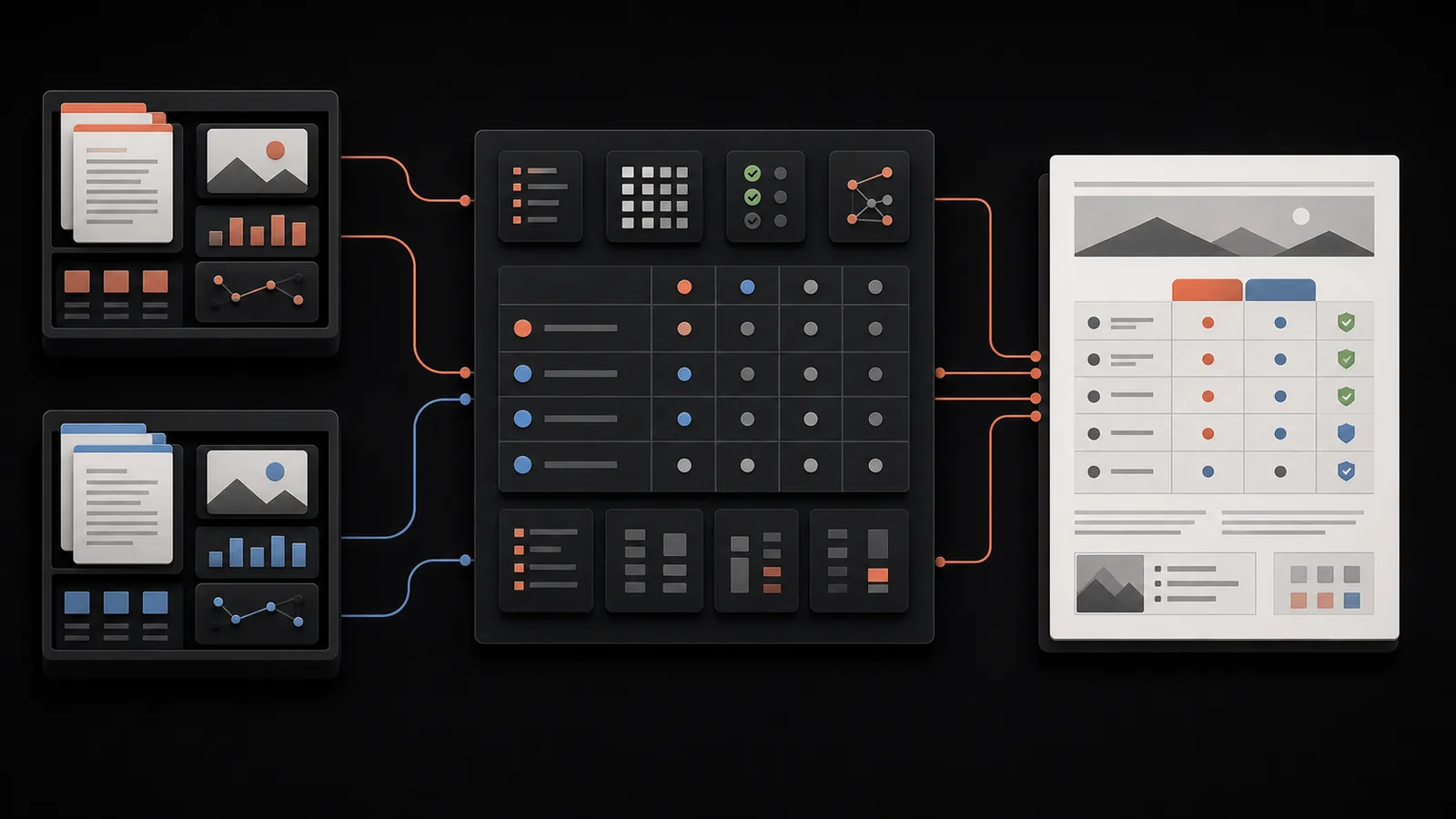
A competitor comparison page is a structured, evidence-based evaluation of products for readers with commercial intent. Claude SEO generates X-versus-Y layouts, alternatives pages, feature matrices, schema markup, and conversion sections while requiring public, verifiable sources for competitor claims.
The command creates an evidence-led editorial draft that remains behind factual, fairness, and publication review.
OUTCOME
A comparison-page draft with a feature matrix, objections, source gaps, and eligible schema recommendations.
REQUIRED INPUT
Use /seo competitor-pages with product facts, the comparison target, competitor URLs, audience, and intended page format.
READINESS
Current public evidence is required. Missing pricing, features, affiliation, or source dates remain explicit gaps.
LOCAL OUTPUT
COMPARISON-PAGE.md, a feature matrix, recommendations, and a schema draft only when visible facts support it.
SIDE EFFECTS
Can fetch public competitor sources and write local draft files. It does not publish the page or prove performance.
COST + APPROVAL
The base route needs no separate SEO-data API. Claude Code and optional research can cost separately; editorial and legal approval remain required.
// HOW IT WORKS
Which competitor page formats can you create?
When you run /seo competitor-pages, Claude SEO uses the product facts, competitor URLs, and public sources you provide to draft comparison content. It proposes structured page layouts, feature matrices, keyword patterns, and schema markup for review. It does not validate rankings or conversion performance.
All competitor information must be verifiable from current public sources. Date pricing, distinguish tested behavior from documented claims, write "Not publicly available" where evidence is missing, disclose product affiliation, and require human editorial and legal review before publication.
Primary references: the US Federal Trade Commission's comparative advertising policy addresses truthful comparisons, and Google's people-first content guidance provides questions for evaluating originality, sourcing, expertise, and reader value.
4 page types you can generate
Each page type starts from a different comparison-intent pattern and proposes a matching layout. The source template requests a minimum 1,500-word outline as an internal production heuristic, not a Google requirement or ranking target.
01
X VS Y COMPARISON
Direct head-to-head comparison between two products. Balanced feature-by-feature analysis with clear verdict and justification. Targets "[Product A] vs [Product B]" keywords.
02
ALTERNATIVES PAGES
List of alternatives to a specific product with brief summary, pros/cons, and best-for use case per entry. Targets "[Product] alternatives" and "best alternatives to [Product]" keywords.
03
BEST-OF ROUNDUPS
Curated list of top tools in a category with clear ranking criteria. Targets "best [category] tools [year]" and "top [category] software" keywords.
04
FEATURE MATRICES
Feature comparison table with multiple products in columns. Sortable and filterable when interactive. Targets "[category] comparison" and "[category] comparison chart" keywords.
05
SCHEMA MARKUP
Drafts Product, SoftwareApplication, or ItemList only when visible, supported facts make the type eligible. Never copy third-party ratings into AggregateRating.
06
CONVERSION LAYOUT
Suggests CTA placements and social-proof sections for testing. Third-party ratings may be cited visibly, but must not be republished as first-party AggregateRating data.
07
KEYWORD TARGETING
Targets 8 high-intent patterns: A vs B, A alternative, A alternatives [year], best [category] tools, A vs B for [use case], A review [year], A vs B pricing, is A better than B.
08
INTERNAL LINKING
Cross-links between related comparison pages. Links to product pages, feature pages, case studies, and testimonials. Breadcrumb structure: Home > Comparisons > This Page.
TRUST
FAIRNESS GUIDELINES
All claims verifiable from public sources. No defamation. Balanced presentation acknowledging competitor strengths. Source citations, affiliation disclosure, and "as of date" pricing disclaimers.
// KEYWORD PATTERNS
8 HIGH-INTENT PATTERNS
The comparison page generator starts from query patterns often associated with comparative research. Its source template applies uncited High and Medium volume labels, so do not treat those labels as measurements. Actual intent and demand must be checked for the target market; the table below keeps only planning intent.
Pattern
Example
Planning intent
[A] vs [B]
"Slack vs Teams"
Direct comparison
[A] alternative
"Figma alternatives"
Alternative research
[A] alternatives [year]
"Notion alternatives 2026"
Current alternatives
best [category] tools
"best project management tools"
Category shortlist
[A] vs [B] for [use case]
"AWS vs Azure for startups"
Use-case comparison
[A] review [year]
"Monday.com review 2026"
Product evaluation
[A] vs [B] pricing
"HubSpot vs Salesforce pricing"
Pricing comparison
is [A] better than [B]
"is Notion better than Confluence"
Decision support
Title tag formulas
X vs Y - [A] vs [B]: [Key Differentiator] ([Year])
Alternatives - [N] Best [A] Alternatives in [Year] (Free & Paid)
Roundup - [N] Best [Category] Tools in [Year], Compared & Ranked
Claude SEO drafts a feature matrix and page structure from the evidence you provide or it can retrieve. Missing facts must remain marked as unavailable. Any schema is a draft and must match visible page content before implementation.
Output files
COMPARISON-PAGE.md - reviewable page structure with sections and a source-template outline of at least 1,500 words
comparison-schema.json - Product, SoftwareApplication, or ItemList JSON-LD draft when the visible content supports it
Keyword strategy - primary and secondary keywords with related long-tail opportunities
Recommendations - content improvements, new comparison opportunities, and conversion optimization suggestions
// FAQ
What should you know about comparison pages?
Claude SEO drafts 4 types of comparison pages: X vs Y head-to-head comparisons, Alternatives to X pages, Best Category Tools roundups, and Comparison Table pages with feature matrices. The draft still requires evidence and editorial review before publication.
It can draft Product, SoftwareApplication, or ItemList JSON-LD when the visible page and item type support that markup. AggregateRating must use ratings shown on the page for the specific item; do not aggregate ratings copied from other sites. ItemList describes a visible list but does not guarantee a Google rich result.
The workflow requires competitor claims to be supported by current public sources, marks unavailable facts instead of guessing, dates pricing, distinguishes tested features from documented claims, cites sources, and discloses product affiliation. A human must review the draft for accuracy, fairness, and legal risk before publication.
The generator uses 8 comparison patterns as planning heuristics: "[A] vs [B]", "[A] alternative", "[A] alternatives [year]", "best [category] tools", "[A] vs [B] for [use case]", "[A] review [year]", "[A] vs [B] pricing", and "is [A] better than [B]". These patterns do not provide measured search volume or guarantee rankings or conversions.
The Claude SEO code is open-source under the MIT license and the base skill does not require a separate paid SEO-data API. Claude Code usage and any optional research or data services can still have their own access requirements and costs.
// RELATED SKILLS
EXPLORE MORE
SEO PLANNING
Strategic SEO planning with competitive analysis, content strategy, and 4-phase implementation roadmap for new or existing sites.