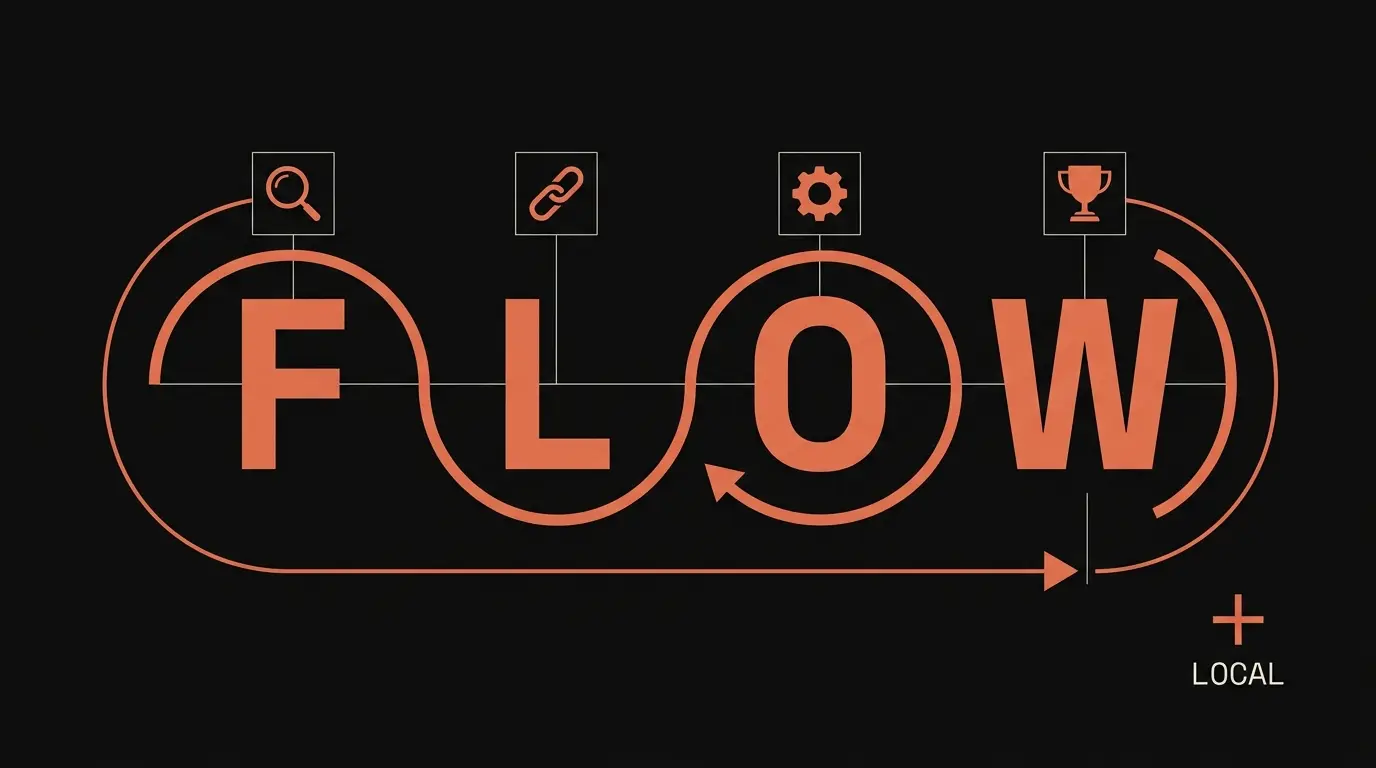
- FLOW is an operating model not a tactic: Find, Leverage, Optimize, Win, plus a Local track
- 41 evidence-led prompts released CC BY 4.0 by Daniel Agrici, MIT skill orchestrator inside Claude SEO
- Context-matched Optimize: the agent picks 2 to 3 prompts from 21 based on vertical, URL signals, prior skill output
- Cross-references built in: FLOW points at the right Claude SEO specialist (cluster, backlinks, content, geo, sxo, local, maps)
- Run
/seo flowfor the stage menu,/seo flow syncto pull upstream updates with SHA-256 lockfile integrity
SEO has a vibes problem in the AI era. Practitioners type ad-hoc prompts at LLMs and hope something sticks. The same query that returned gold last week returns a confident hallucination this week, and there is no audit trail. FLOW fixes that with a structured prompt library, a 4-stage operating model, and a Local track that handles the entire local-search loop as a first-class branch.
This guide walks through the framework end to end: what the five stages cover, how the 41 prompts are distributed, how Claude SEO picks 2 to 3 of 21 Optimize prompts based on context, and where each stage hands off to a specialist sub-skill. By the end you will have a clear path from /seo flow with no arguments to a context-matched Optimize run on a real URL.
What is FLOW?
FLOW stands for Find, Leverage, Optimize, Win. Each letter is a stage in the customer and ranking lifecycle, not a tactic. Find is where you map the search market and the topical surface area. Leverage is how you amplify authority that compounds over time. Optimize is the implementation work, the on-page, technical, content, freshness, and structured-data passes. Win closes the loop with conversion analysis and persona scoring so traffic actually pays off.
The Local track sits beside the main loop. Google Business Profile optimization, NAP consistency, citations, and map pack strategy all behave differently from regular organic, so FLOW handles them as their own stage with 11 dedicated prompts rather than squeezing them into Optimize.
The framework is mine, originally published at github.com/AgriciDaniel/flow under CC BY 4.0. The /seo flow skill brings it inside Claude SEO so any user can run stage-specific analysis on a target URL with one command.
What do the 41 prompts cover?
FLOW ships with 41 prompts spread across the five stages. The distribution reflects where implementation work actually lives, which is mostly inside Optimize.
| Stage | Prompts | What they cover |
|---|---|---|
| Find | 5 | Keyword research, SERP intent mapping, gap analysis |
| Leverage | 1 | Off-site authority strategy |
| Optimize | 21 | On-page, technical, content quality, freshness, structured data |
| Win | 3 | BOFU, conversion, dual-surface scorecard |
| Local | 11 | GBP, local content, citations, map pack, location-page tuning |
Each prompt requires evidence-tagged output. The model has to cite what data or page element supports a finding, and what additional data would strengthen or invalidate it. That is the difference between a recommendation a junior consultant can defend and one they cannot.
The Find stage gets 5 prompts because keyword research splits cleanly into intent buckets. The Leverage stage gets 1 because off-site authority is one strategic question with many tactical answers. Optimize gets 21 because that is where most SEO implementation work actually lives, and where matching the right prompt to the right page matters most. Win gets 3 because the conversion side of SEO is bounded by a small number of repeatable questions. Local gets 11 because local search has its own ranking surface and its own quirks.
Every prompt in the library names its trigger conditions explicitly. You can read references/prompts/README.md to see, for each prompt, when it should fire and which prior signal it depends on. That makes the framework reviewable by humans as well as runnable by agents. A junior team member can read the index and learn the operating model without ever running the skill.
How does context matching work for Optimize?
Naively dumping all 21 Optimize prompts at a URL is noise. The seo-flow agent never does that. It reads the prompt file names first, fetches the target URL, then selects 2 or 3 prompts that match the page's industry signals, content gaps, or technical issues. Context-matched, not a dump.
The selection priority is explicit:
- Industry vertical: SaaS pages get on-page and technical Optimize prompts. Local-business pages get citations and GBP. Publishers get E-E-A-T and freshness.
- URL signals: product pages get conversion-leaning prompts, blog posts get freshness and authority, pricing pages get persuasion and CRO.
- Prior skill output: anything Claude SEO already flagged in the conversation feeds the picker.
Concrete example. You run /seo technical https://example.com/pricing on a SaaS pricing page. The technical pass surfaces 4 crawlability and indexability issues. You then run /seo flow optimize https://example.com/pricing. The agent reads the prior conversation, sees the technical findings, and loads only the 3 technical-leaning Optimize prompts. It skips the content-quality and freshness prompts because they would compete with work the technical pass already covered. The output cites which prompts ran and why.
This is the difference between a prompt library and a prompt framework. A library hands you 21 things you could try. A framework hands you the 2 or 3 you should try, given what your page actually looks like. The seo-flow agent is the discrimination layer, and it shows its work: every Optimize run includes a one-line rationale per prompt explaining why the agent picked it for this specific page.
Cross-references to other skills
FLOW does not replace the rest of Claude SEO. Every stage points at the specialist sub-skill that goes deeper on the same data.
- Find points at /seo cluster for SERP-overlap clustering across larger keyword sets
- Leverage points at /seo backlinks for raw referring-domain data and anchor analysis
- Optimize points at /seo content for E-E-A-T depth and /seo geo for AI-citation readiness
- Win points at /seo sxo for persona scoring and Search Experience Optimization
- Local points at /seo local for full local audits and /seo maps for geo-grid rank tracking
The orchestration logic is the same in both directions. If you start with /seo content and the analysis surfaces a freshness gap, FLOW Optimize is the right next step. If you start with /seo flow win and conversion data is missing, /seo sxo is where you go for persona-level scoring. FLOW is the conductor, the specialist skills are the section leads.
This is also why the Optimize stage does not duplicate work that /seo content or /seo geo already cover at depth. FLOW Optimize gives you the framework-level pass that fits in a single conversation. When that pass says you need 5,000 words of E-E-A-T analysis on author bios across the site, you switch to the specialist. The handoff is explicit, not implicit.
Why CC BY 4.0
The 41 prompts are released under CC BY 4.0 by Daniel Agrici. Open source means the framework can be forked, extended, translated, and contributed back. Attribution is the only requirement, and it is automated. The sync script writes the attribution header into references/prompts/README.md on every pull, so you cannot accidentally strip it.
The skill that orchestrates the prompts inside Claude SEO is MIT licensed, the same as every other Claude SEO sub-skill. That split matters. The content (prompts) carries an attribution requirement because authorship is the value. The code (orchestrator) is unrestricted because portability is the value.
Security hardening
The FLOW integration shipped in Claude SEO v1.9.5 and went through a same-day security audit in v1.9.6. 10 audit findings closed, anonymous-first GitHub sync, SHA-256 lockfile, atomic writes, 5 MB response cap, allowlisted endpoints. The seo-flow agent has no Bash access. The sync script sends zero credentials by default and only escalates to a PAT on a 403 fallback.
Full breakdown of the audit and the threat model in the v1.9.6 security hardening post. New installs should pin to v1.9.6 or later.
How to start
Five steps to go from zero to FLOW output.
- Install Claude SEO from the install page
- Run
/seo flowwith no arguments to see the stage menu and pick where you are - Run
/seo flow find <topic>if you are starting fresh with a keyword space - Run
/seo flow optimize <url>if you have an existing page that needs work - Run
/seo flow syncperiodically to pull upstream prompt updates with drift report and SHA-256 lockfile integrity check
claude /install github:AgriciDaniel/claude-seo
/seo flow
/seo flow optimize https://yourdomain.com/pricing
That is the whole entry path. The skill page at /skills/seo-flow has the command reference and the orchestration logic in full.
Conclusion
FLOW is the antidote to vibes-based AI SEO. Five stages, 41 evidence-led prompts, context-matched orchestration, open-source attribution, security-audited sync. Try it free with Claude SEO and let the framework do the picking instead of typing prompts by hand.