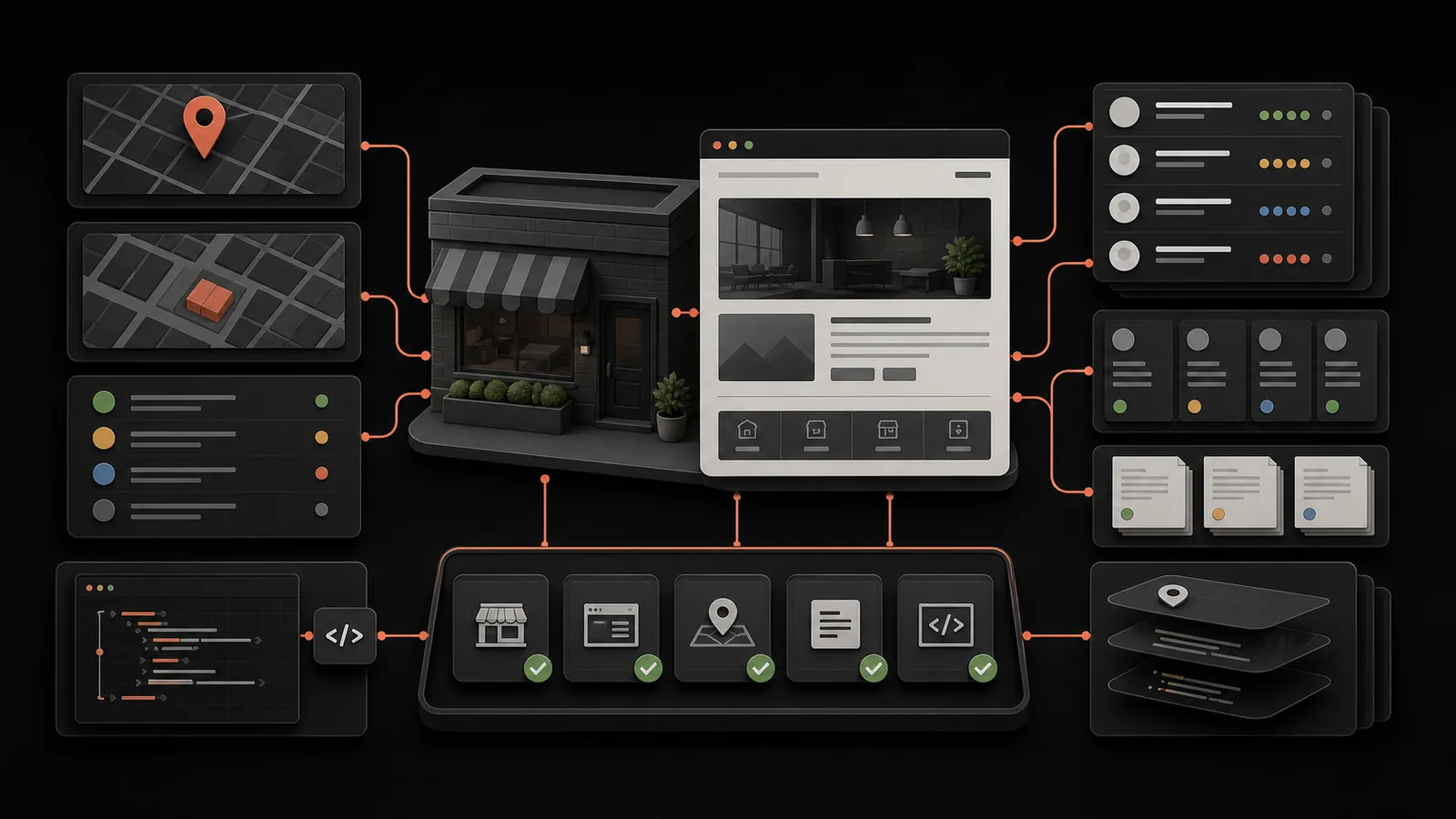
A local SEO audit is an assessment of the signals that help a business appear for location-based searches. Claude SEO checks Google Business Profile optimization, NAP consistency, citations, reviews, local schema, location pages, multi-location structure, business type, and industry-specific requirements.
The base command reviews public page evidence. Live listings and local-result enrichment are optional paid paths.
OUTCOME
A prioritized local-page diagnostic with unavailable live fields labeled rather than guessed.
REQUIRED INPUT
One reachable business-page URL supplied to /seo local <url>.
READINESS
Core review needs public page access. Live profile, listing, review, and local SERP evidence needs connected paid provider access.
LOCAL OUTPUT
LOCAL-SEO-ANALYSIS-{domain}.md with page evidence, unknowns, checklist findings, and prioritized actions.
SIDE EFFECTS
Fetches the public page, can call an approved provider, and writes a local report. It does not edit the site or business profile.
COST + APPROVAL
Estimate and approve paid calls. Verify business facts and approve any schema, listing, or profile change separately.
// HOW IT WORKS
What does a local SEO audit cover?
When you run /seo local, Claude SEO fetches your page, detects your business type (brick-and-mortar, service area business, or hybrid), identifies your industry vertical (restaurant, healthcare, legal, home services, real estate, or automotive), and then analyzes 6 weighted dimensions of local SEO performance.
Google says local results are primarily based on relevance, distance, and prominence. Claude SEO turns those broad principles into observable checks across the business profile, reviews, local page content, NAP consistency, structured data, and local authority signals. The score is an internal audit framework, not a Google ranking-factor formula.
What each dimension analyzes
The 6 dimensions cover every aspect of local search visibility. The analysis adapts based on your detected business type and industry vertical, applying different checks and benchmarks for each.
25%
GBP SIGNALS
PRIMARY FACTOR
GBP embed detection, primary and secondary category relevance, posts, photos and video evidence, business hours visibility, and verification signals. Category recommendations must match the services actually offered.
20%
REVIEWS AND REPUTATION
RECENCY CHECKS
Review count, rating, recency, velocity, aggregateRating markup, third-party review presence, owner response patterns, and possible review-gating signals. Thresholds are labeled as heuristics when used.
20%
LOCAL ON-PAGE SEO
PAGE RELEVANCE
City and service relevance in titles and headings, visible NAP, useful service pages, embedded maps where appropriate, click-to-call controls, internal linking, and multi-location quality gates with a doorway-page swap test.
15%
NAP CONSISTENCY AND CITATIONS
AI VISIBILITY
NAP extraction from page HTML, schema, and visible profile data with cross-source comparison. Reviews selected directory listings and awareness of Apple Business Connect and Bing Places.
10%
LOCAL SCHEMA MARKUP
6 VERTICALS
LocalBusiness schema validation with correct industry subtype (Restaurant, LegalService, MedicalClinic, AutoDealer). Required and recommended properties check. Geo coordinates with 5+ decimal precision. Multi-location branchOf linking. Industry-specific patterns like Menu for restaurants and Physician for healthcare.
10%
LOCAL LINKS AND AUTHORITY
BRAND MENTIONS
Reviews relevant Chamber of Commerce links, accreditation signals, local news coverage, community involvement, and other earned local references. Mentions are assessed for relevance and evidence, not treated as guaranteed ranking or citation factors.
// SCORING
How does the local SEO score work?
The local SEO score is a weighted 0-100 aggregate across 6 dimensions. Each dimension produces findings based on your detected business type and industry vertical. The final score tells you exactly where your local presence stands and what to fix first.
GBP SIGNALS
25%
REVIEWS
20%
LOCAL ON-PAGE
20%
NAP / CITATIONS
15%
LOCAL SCHEMA
10%
LOCAL LINKS
10%
How to interpret the local audit
Evidence
Interpretation
Google Business Profile signals
Check category and listing completeness against the real business
Reviews
Assess count, rating, recency, responses, and policy compliance in context
NAP and citations
Flag observed inconsistencies and identify profiles that need manual verification
Location pages
Review crawlability, unique local value, structured data, and doorway-page risk
Limitations
Do not infer live map-pack position, profile analytics, or comprehensive backlinks without connected data
Optional live listing and local SERP enrichment requires the user's DataForSEO credentials and consumes paid credits. Core page analysis works without DataForSEO. Paid calls should run only after a cost estimate and confirmation.
Output
The audit produces a LOCAL-SEO-ANALYSIS-{domain}.md file with local SEO score, dimension breakdown, business type and industry detection, GBP optimization checklist, review health snapshot, NAP consistency audit, citation presence check, local schema status, location page quality assessment, and top 10 prioritized actions.
// DETECTION
How are business type and industry detected?
Business type detection
The audit detects your business type from page signals before analysis begins. This determines which checks apply.
Brick-and-mortar - physical street address visible in page content or footer, Google Maps embed with pin/directions, structured address in LocalBusiness schema
Service Area Business (SAB) - no visible physical address, service area mentions ("serving [city/region]"), "we come to you" language, areaServed in schema without streetAddress
Hybrid - both physical address and service area language present, such as "visit our showroom" combined with "we also serve [areas]"
SABs skip embedded map verification and physical address consistency checks. Brick-and-mortar businesses get full NAP and map checks.
Industry vertical detection
The audit detects your industry vertical from page signals and routes to industry-specific checks, schema patterns, and citation source recommendations.
Vertical
Detection signals
Restaurant
/menu, menu items, reservations, cuisine types, food ordering, "dine-in", "takeout"
Healthcare
Insurance accepted, patients, appointments, NPI, medical terms, "Dr.", HIPAA notice
Legal
Attorney, lawyer, practice areas, bar admission, case results, "free consultation"
Home services
Service area, emergency service, "free estimate", licensed/insured/bonded, "24/7"
Real estate
Listings, MLS, properties for sale/rent, agent bio, brokerage, "open house"
Automotive
Inventory, VIN, test drive, dealership, service department, "new/used/certified"
If no vertical is detected, the analysis uses the generic LocalBusiness path.
The audit analyzes all 6 dimensions, detects your business type and industry, and produces a scored report with prioritized recommendations. If no local signals are detected, the audit reports this clearly and suggests confirming the URL is for a local business.
// FAQ
QUESTIONS ABOUT LOCAL SEO AUDITS
The audit checks for visible profile references, category relevance, posts, photos and video evidence, business hours, and verification signals. It compares every recommendation with the services and location information shown on the site. Profile data that cannot be retrieved is reported as unverified rather than guessed.
The audit extracts the business name, address, and phone number from visible page HTML, LocalBusiness JSON-LD, and any visible profile data. It flags observed discrepancies and checks selected directory listings where data is available. Apple Business Connect and Bing Places are recommended as profiles to verify, not assumed to be ranking guarantees.
Claude SEO detects three business types from page signals: brick-and-mortar (physical street address, Google Maps embed, directions), Service Area Business or SAB (no visible address, service area mentions, mobile service language), and hybrid (both physical address and service area language). It also detects 6 industry verticals: restaurant, healthcare, legal, home services, real estate, and automotive. Each vertical gets tailored schema recommendations, citation source lists, and industry-specific checks like HIPAA considerations for healthcare or menu schema for restaurants.
The audit checks visible review count, rating, recency, velocity, aggregateRating markup, third-party review presence, owner response patterns, and possible review-gating signals. Any benchmark is labeled as a heuristic and tied to its source. Findings are prompts for manual review, not proof of a ranking penalty or legal violation.
Yes. The audit checks store-locator crawlability, location URL structure, unique LocalBusiness schema with an individual @id per location, Organization relationships, and location-page quality. A swap test flags pages that remain interchangeable after the city name changes. At 30 or more location pages the quality review becomes stricter, and at 50 or more pages the workflow requires explicit justification before continuing.
// RELATED SKILLS
EXPLORE MORE
MAPS SEO
Tier 0 supports public-data discovery, geocoding, manual GBP and NAP guidance, and schema drafting. Live geo-grid tracking, GBP fields, and review intelligence require paid DataForSEO access.
Detect, validate, and generate Schema.org structured data in JSON-LD format. Validates against current Google requirements including LocalBusiness subtypes.