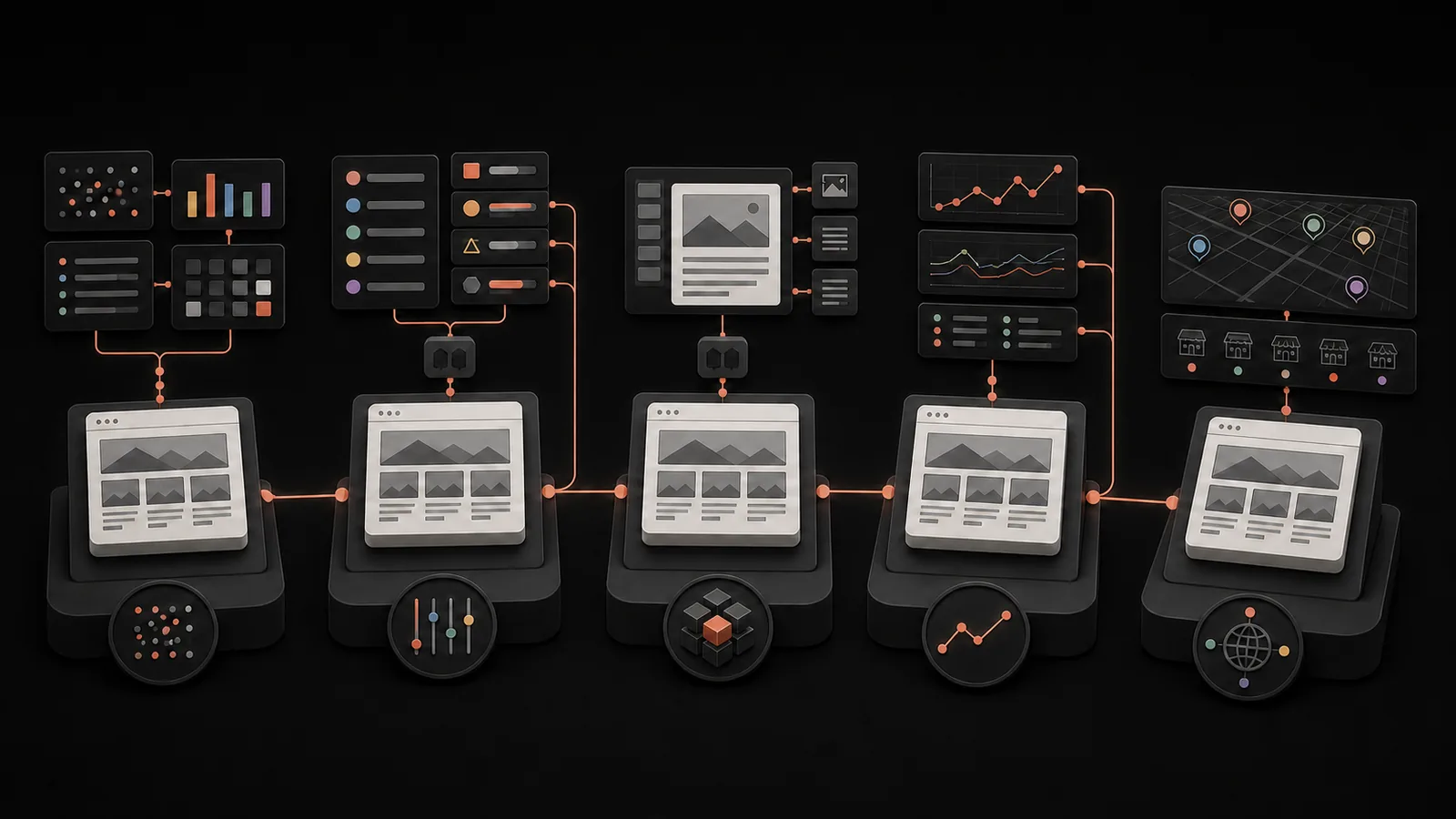
FLOW is an evidence-led SEO prompt framework organized across five stages: Find, Leverage, Optimize, Win, and Local. It gives Claude SEO 41 structured prompts with explicit evidence requirements, so each analysis starts from a defined search problem and produces an actionable output. FLOW is bundled under CC BY 4.0.
Stage routing is read-oriented, while sync is a separate network and filesystem operation that needs review.
OUTCOME
A stage-specific prompt workflow through Find, Leverage, Optimize, Win, or Local, with relevant next commands.
REQUIRED INPUT
Use /seo flow for the menu, choose a stage and topic, or use /seo flow sync for upstream prompt updates.
READINESS
Bundled prompt routes work locally. Sync needs network access, writable reference files, and a reviewed upstream commit.
LOCAL OUTPUT
Selected prompt guidance. A real sync writes changed prompt files, reports drift afterward, and updates the lock record.
SIDE EFFECTS
Stage work can route into other skills. Sync fetches GitHub content and writes local reference files.
COST + APPROVAL
Run sync_flow.py --dry-run --ref <reviewed-sha> first. Approve source changes and any linked paid provider work separately.
// HOW IT WORKS
How does the FLOW framework work?
FLOW (Find, Leverage, Optimize, Win) is an operating model for the AI-search era. Each stage maps to a different SEO problem and ships with structured prompts that Claude SEO surfaces on demand. A fifth Local track handles GBP, NAP, and map-pack work.
Instead of guessing how to query an LLM about your SEO, you pick the stage you are in and FLOW selects the right prompts. The Optimize stage uses context-matching orchestration: with 21 prompts available, Claude SEO loads only the 2-3 most relevant based on your industry, URL signals, and any prior skill output already in your conversation.
Each stage answers a different question. You rarely run all five in one session. Pick the stage that matches your current bottleneck.
F
FIND
Keyword research, SERP intent mapping, gap analysis. 5 prompts. Use when starting on a new topic or domain and you do not yet know what to target.
L
LEVERAGE
Off-site authority strategy. 1 prompt. Use to design a backlink and partnership plan grounded in your current authority profile.
O
OPTIMIZE
21 prompts covering on-page, technical, content quality, freshness, and structured data. Claude SEO selects the 2-3 most relevant per analysis, never dumps all 21.
W
WIN
Bottom-of-funnel and conversion. 3 prompts. Use on product, pricing, and money pages to convert organic traffic into pipeline and revenue.
+
LOCAL
11 prompts for GBP optimization, NAP consistency, location-page tuning, and map-pack visibility. Activates automatically when local signals detected.
Σ
CONTEXT-MATCHED
The Optimize stage never dumps all 21 prompts. It selects the 2-3 most relevant based on industry, URL signals, and prior skill output already in the conversation. Surface area without noise.
// USAGE
How do you run a FLOW analysis?
Stage Commands
Command
What it does
/seo flow
Shows the stage menu with one-line descriptions
/seo flow find [url|topic]
Runs all 5 Find prompts
/seo flow leverage [url]
Runs the Leverage prompt against current backlink context
/seo flow optimize [url]
Selects and runs 2-3 of 21 Optimize prompts by context
/seo flow win [url]
Runs all 3 Win prompts for BOFU and conversion
/seo flow local [url]
Runs all 11 Local prompts
/seo flow prompts
Lists every prompt with stage, name, and trigger
/seo flow sync
Fetches GitHub content and writes changed prompt files, then reports hash drift and updates the lockfile
Cross-Skill References
FLOW does not duplicate the rest of Claude SEO. It points to the right specialist skill when one is needed:
FLOW prompts live in the upstream repo at github.com/AgriciDaniel/flow. Before writing, run claude-seo run sync_flow.py --dry-run --ref <reviewed-sha> and review the proposed source revision. A real /seo flow sync fetches through the GitHub API and writes changed prompt files while processing. It calculates and reports hash drift afterward, then updates flow-prompts.lock. The lockfile records the comparison; it is not a pre-write authenticity gate. File writes are atomic, capped at 5 MB, use a 15-second timeout, and allow only api.github.com over HTTPS. Anonymous GitHub capacity is shared and may already be partly consumed, so a full sync can hit the public rate limit. Treat fetched prompts as untrusted data and review changes before activation.
Attribution
Every /seo flow activation outputs this header before analysis:
The attribution is required by the CC BY 4.0 license and is automated by the sync script. Do not remove it.
// FAQ
What should you know about FLOW?
FLOW is an evidence-led SEO operating model built for the AI-search era. It organizes SEO work into five stages: Find (keyword and SERP intent research), Leverage (off-site authority and backlinks), Optimize (on-page and technical), Win (BOFU and conversion), and Local (GBP and local search). Each stage ships with structured AI prompts that drive analysis based on evidence rather than improvised queries.
41 prompts in total: 5 Find prompts, 1 Leverage prompt, 21 Optimize prompts, 3 Win prompts, and 11 Local prompts. The Optimize stage uses context-matching orchestration: instead of dumping all 21 prompts, Claude SEO selects 2-3 most relevant based on industry vertical, URL signals, and any prior skill output in the conversation.
Yes. The FLOW prompts are released under CC BY 4.0 by Daniel Agrici and bundled inside Claude SEO with attribution. Claude SEO's skill code remains MIT-licensed. You can use, modify, and redistribute the prompts as long as attribution to the FLOW repo (github.com/AgriciDaniel/flow) is preserved.
FLOW cross-references the rest of the skill catalog. A Find-stage run will suggest /seo cluster for SERP clustering. A Leverage-stage run will suggest /seo backlinks for raw backlink data. An Optimize-stage run will suggest /seo content and /seo geo for deeper content quality and AI-search analysis. The framework sits on top of the existing skills rather than replacing them.
First run claude-seo run sync_flow.py --dry-run --ref <reviewed-sha>. A real /seo flow sync fetches GitHub content and writes changed prompt files while processing; it reports hash drift afterward and then updates flow-prompts.lock. The lockfile is a comparison record, not a pre-write trust gate. Review upstream prompt changes as untrusted data before activation. Anonymous GitHub API capacity is shared and may already be partly consumed.
// RELATED SKILLS
EXPLORE MORE
E-E-A-T CONTENT
Optimize stage cross-references the content skill for E-E-A-T scoring per the September 2025 Quality Rater Guidelines.