
Local SEO is the work of making a real business eligible, accurate, relevant, trusted, and easy to choose when people search in a place. It covers two connected surfaces: local results in Google Maps and Search, and the normal organic pages that answer local intent.
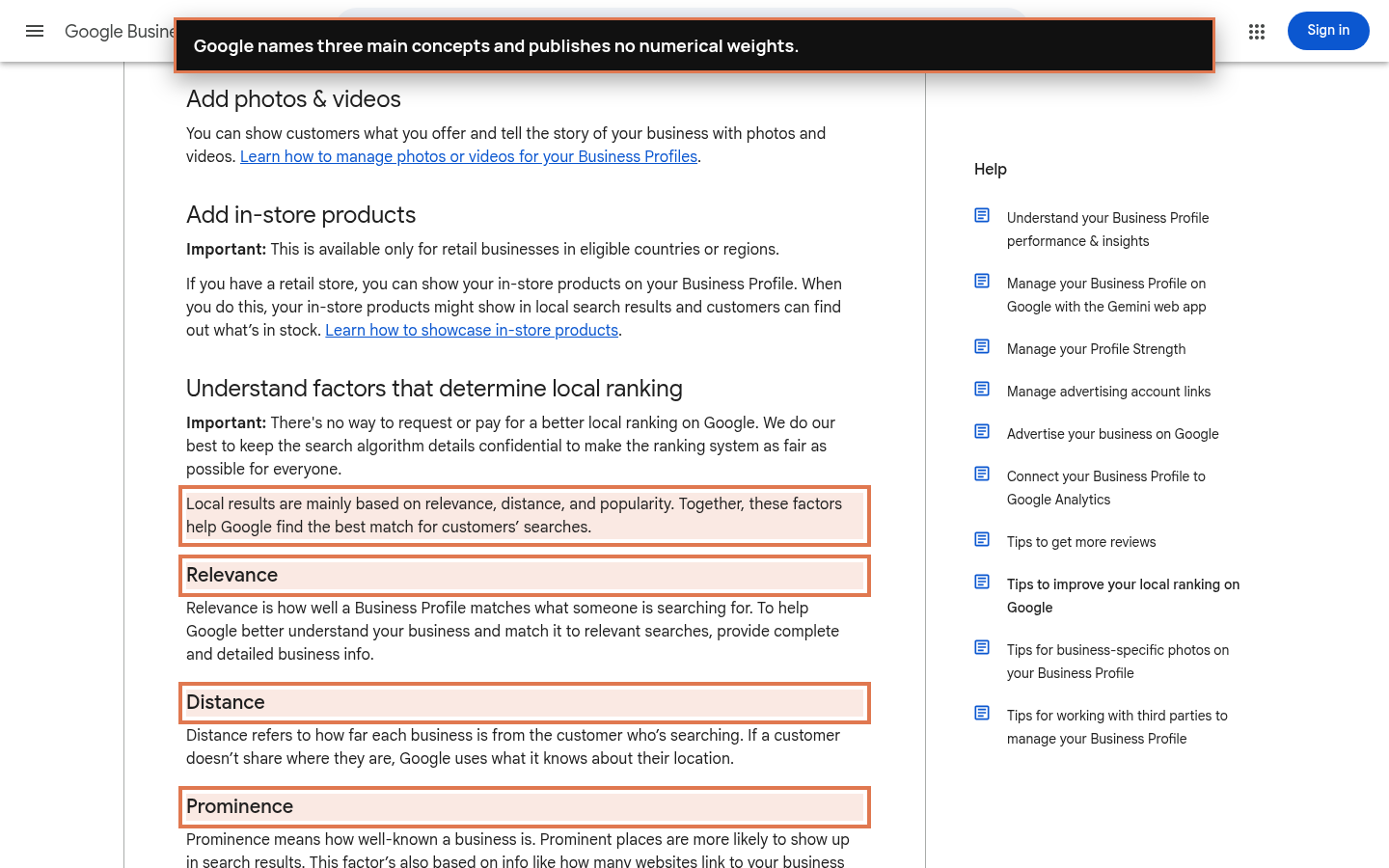
Google says its local results are mainly based on relevance, distance, and prominence. It does not publish numerical weights, and it says there is no way to request or pay for a better organic local ranking. That makes the durable strategy less exciting than most hack lists, but much more useful:
Make it true. Make it complete. Make it useful. Make it trusted. Measure what customers do.
This guide shows how to do that without keyword stuffing a business name, buying reviews, creating virtual locations, mass-producing thin city pages, or pretending schema markup guarantees rankings.
The 60-second answer
- Start with eligibility. A storefront, service-area business, or hybrid can be eligible for a Google Business Profile when it follows the relevant rules. Online-only businesses, lead generators, P.O. boxes, and many virtual-office arrangements are not eligible.
- Treat Maps and the website as two workstreams. The Business Profile helps Google and customers understand the entity. The website proves services, locations, expertise, and conversion options in more depth.
- Improve what you can control. Complete facts, accurate categories, useful pages, representative photos, genuine reviews, relevant local references, and clear conversion paths are workable inputs. Searcher distance is largely a real-world constraint.
- Use a neutral review system. Ask eligible customers for honest feedback. Do not offer incentives, screen for happy customers, discourage negative reviews, or script the rating.
- Measure actions, not screenshots. Track calls, directions, website clicks, forms, bookings, revenue where available, and organic trends. A rank grid or audit score is a diagnostic, not the business outcome.
Policy before tactics: If the profile represents a location or business model that is not eligible, solve ownership, eligibility, or representation first. More citations and content do not repair a policy defect.
A faster summary in Daniel's voice
Press play for the operating model in under two minutes. The transcript follows the audio and can also be used to seek.
AI-generated audio using Daniel's authorized cloned voice at 1.1x speech speed. Soft background music is looped at 5% linear gain with fade in and fade out. Duration: 1:41.
What local SEO includes
Local SEO is not one ranking system. It is a coordinated set of entity, profile, website, reputation, and measurement practices.
For Google, the most visible local surface is often a map with a small group of business results, commonly called the Local Pack or Map Pack. A second surface is the ordinary organic list, where service pages, location pages, directories, publishers, and other sites can rank for the same local need. A business can perform differently in these two systems because the available signals and result formats are not identical.
The practical response is to run two linked workstreams:
| Workstream | Main job | Typical assets | Useful outcome |
|---|---|---|---|
| Business entity and listings | Represent one real business accurately on local platforms | Google Business Profile, Apple Business, Bing Places, industry profiles | Eligibility, accurate discovery, calls, directions, bookings, and profile visits |
| Website and organic search | Explain the offer, location, expertise, and next step in depth | Service pages, location pages, contact page, proof, internal links, structured data | Relevant organic visibility, qualified visits, forms, calls, and bookings |
The workstreams reinforce each other. Google says it can build Business Profile and local-result information from owner input, public web content, licensed data, user contributions, and its own interactions. That is a reason to maintain accurate public facts. It is not proof that repeating an identical name, address, and phone string across a fixed number of directories creates a guaranteed ranking lift. See Google's explanation of local business information sources.
An evidence label for every tactic
Local SEO advice becomes safer when each recommendation carries one of three labels:
- Confirmed platform guidance: the platform or regulator documents the rule, feature, or limitation.
- Practitioner interpretation: experienced operators consider the tactic useful, but the platform does not publish it as a ranking factor or give it a causal weight.
- Unverified folklore: the claim lacks adequate evidence, conflicts with policy, or is recycled without a traceable method.
This guide puts business accuracy, eligibility, genuine reviews, useful content, visible-data parity, and measurement in the first category. It treats exact ranking weights, fixed citation counts, fixed review targets, geotagged-photo claims, and guaranteed timelines as unsupported.
Eligibility before optimization
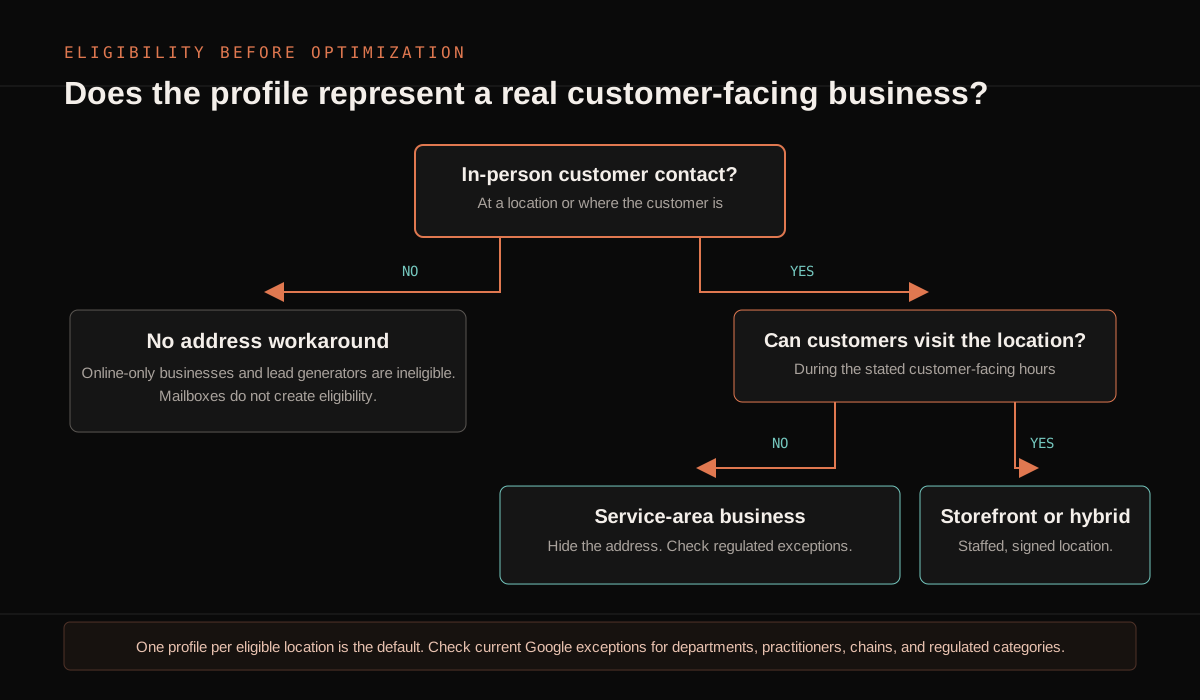
Google's current eligibility guidance centers on in-person contact with customers during stated hours. The representation rules then define how different business models should show an address or service area. Read the eligibility and ownership guidance and representation guidelines before creating or restructuring profiles.
Choose the real business model
| Business model | Profile direction | Address treatment | Common risk |
|---|---|---|---|
| Storefront | Eligible when customers can visit a real, staffed location during stated hours and the address-showing location meets Google's permanent fixed-signage rule | Show the accurate customer-facing address | Using an address with no real operations, signage, or permanent presence |
| Service-area business | Eligible when staff travel to customers, subject to Google's category restrictions | Hide an address where customers are not served and define a realistic service area | Exposing a home address, creating profiles for unstaffed areas, or ignoring a regulated-category exception |
| Hybrid | Eligible when customers can visit and staff also travel to them, with permanent fixed signage at the address-showing location | Show the real staffed storefront and add a service area | Calling a location a storefront when customers cannot actually visit |
| Online-only business | Generally not eligible for a Business Profile | No local address workaround | Renting a mailbox or virtual office to manufacture eligibility |
| Lead-generation agent or company | Ineligible under Google's stated policy | No profile workaround | Creating profiles that collect or redirect leads |
| Multi-location business | One profile per distinct, eligible location with separate real operations | Use the accurate location address and location-specific contact path | Duplicate profiles, city modifiers in names, or empty locations |
A rented mailing address where the business does not operate is ineligible. Service-area businesses cannot list a virtual office unless it is staffed during business hours, and businesses that show an address must meet the applicable signage and customer-reception rules. Service-area businesses that do not serve customers at their base should hide the address. Google's current eligibility page also says businesses associated with age-restricted products or services, including alcohol, cannabis, or weapons, cannot operate as service-area businesses without a storefront. These are policy requirements, not optional conversion tips.
The one-profile principle
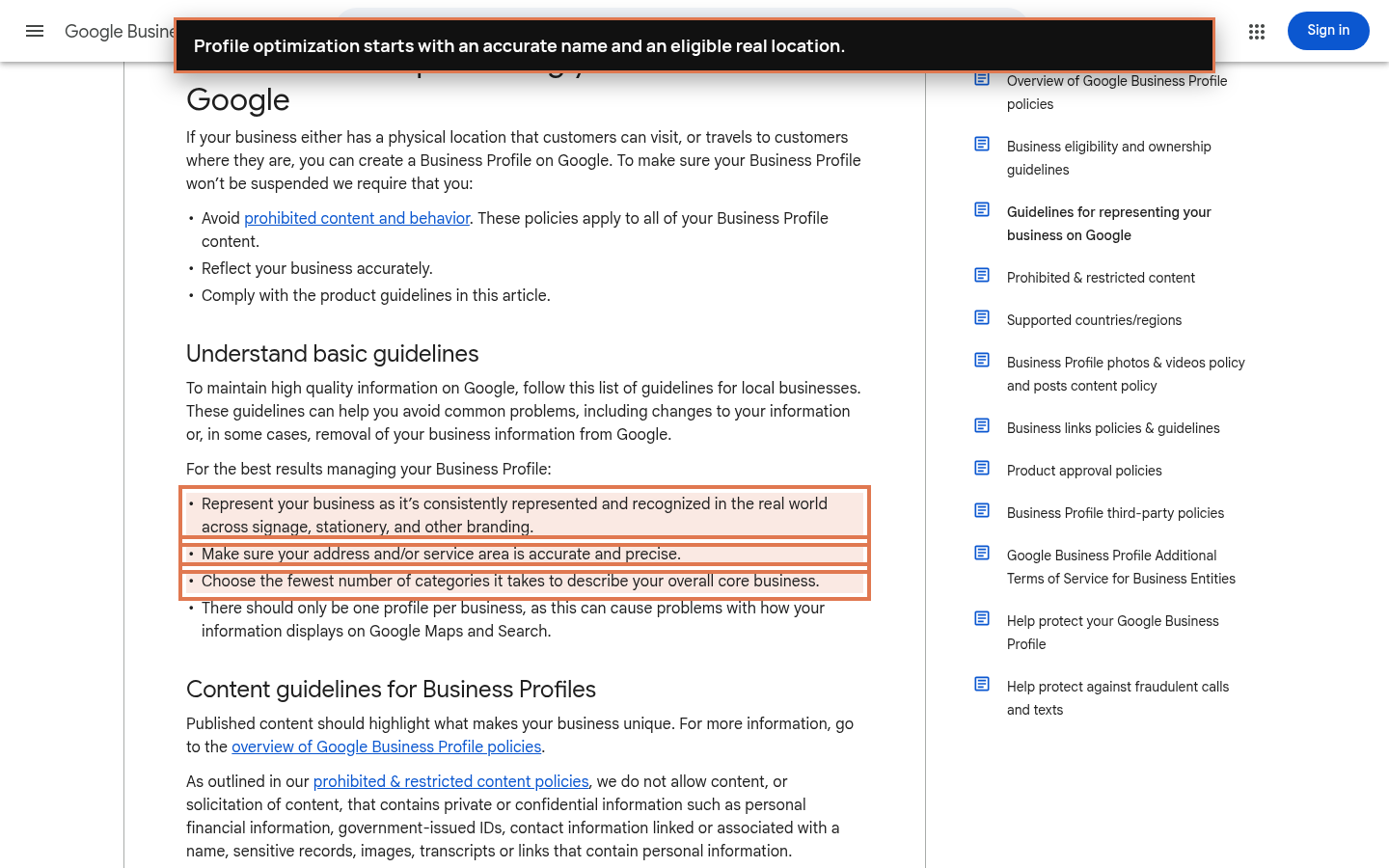
Google's general rule is one profile per business location, with documented exceptions for eligible departments and individual practitioners. Duplicate profiles can split reviews, confuse customers, and create ownership problems. Before creating a new profile, search Maps, confirm existing ownership, and document the correct owner and managers.
For a multi-location brand, each page and profile should map to a real operating location. A location page without distinct operations should not be used to justify a new profile.
How Google says local ranking works
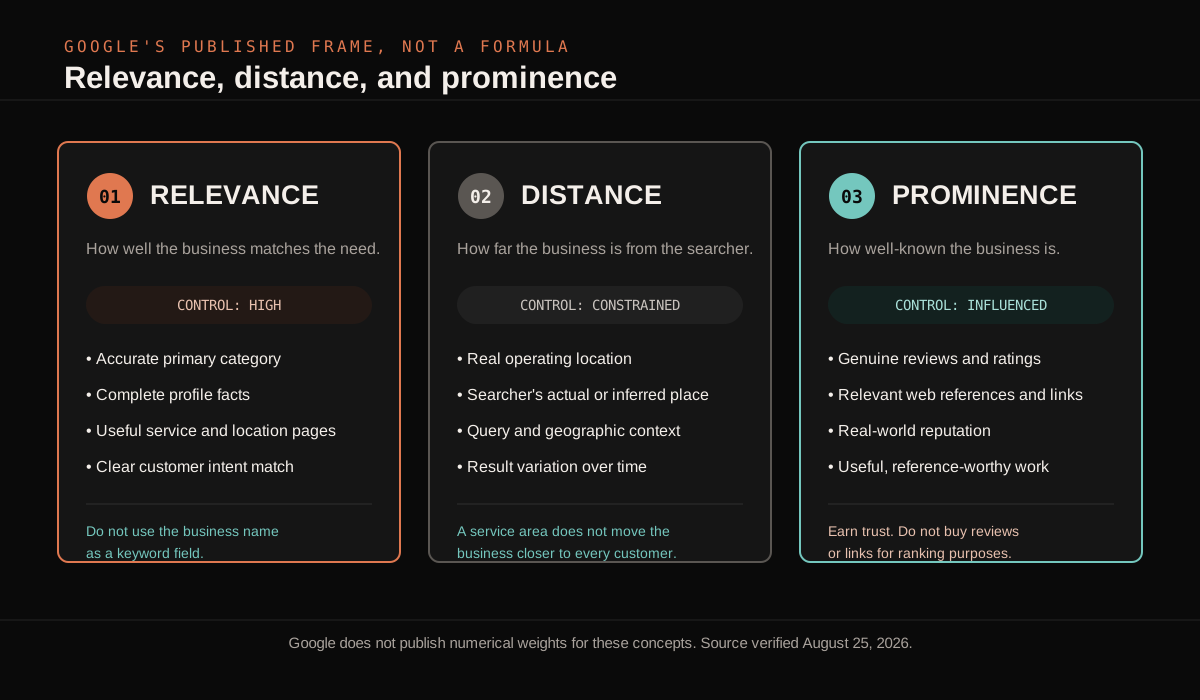
Google's local ranking guidance names three main concepts: relevance, distance, and prominence. It also recommends verification, complete and accurate information, current hours, review responses, and representative photos and videos.
Google does not publish a scoring formula for the three concepts. Any audit tool or industry survey that assigns percentages is creating an operating model, not revealing Google's weights.
The current overview sentence uses the word “popularity,” while the detailed section heading remains “Prominence.” This guide uses the section label and treats it as Google's documented qualitative concept, not as a measurable percentage.
Relevance: does the business match the need?
Relevance is how well a Business Profile matches the search. Complete and detailed profile information can help Google understand the business. The website can add depth through clear service descriptions, location context, evidence, and internal links.
Workable relevance inputs include:
- The most specific accurate primary category.
- A small set of accurate additional categories where needed.
- Complete services, products, attributes, and customer-facing information.
- A website page that directly answers the service and location need.
- Clear, natural language rather than repeated keyword blocks.
The business name is not a keyword field. Google says the profile name should match the real-world name used on signage, the website, stationery, and customer-facing branding. Extra service or location terms can trigger restrictions or suspension.
Distance: what you cannot optimize away
Distance is how far the business is from the searcher's location, or from the location Google infers when the searcher does not specify one. A service area tells customers where a business operates, but it does not move the actual business closer to every searcher.
This is an important planning boundary. You can improve accuracy and coverage, but you cannot honestly guarantee the same visibility from every neighborhood. A rank grid can show geographic variation, yet it remains a snapshot shaped by query, time, device, location, and result changes.
Prominence: real-world and web reputation
Google describes prominence as how well-known a business is. Its current page mentions links to the business, review quantity, and positive ratings as examples. That supports work on genuine reputation and relevant web references. It does not support a universal recipe such as “build 100 citations” or “get exactly ten reviews each month.”
Useful prominence work looks like normal business development:
- Earn coverage for work, research, events, or expertise that is genuinely notable.
- Join relevant local and industry organizations when the membership itself has value.
- Build partner, supplier, venue, association, school, charity, or community relationships that make sense offline.
- Invite honest customer reviews through a compliant process.
- Publish resources worth referencing.
The controllability matrix
| Input | Control level | Practical response |
|---|---|---|
| Real-world business model and staffed locations | Constrained | Represent reality accurately. Do not manufacture locations. |
| Searcher distance | Mostly not controlled | Measure geographic variation and focus on qualified service areas. |
| Profile completeness and categories | Controlled | Keep facts complete, specific, accurate, and current. |
| Website usefulness and conversion path | Controlled | Build helpful local pages and clear next steps. |
| Customer experience | Influenced, not fully controlled | Improve operations and close the feedback loop. |
| Review volume and positive ratings | Influenced, not controlled | Ask neutrally and consistently. Never buy or gate feedback. |
| Relevant local references | Influenced | Earn references through real work and relationships. |
| Algorithm changes and result layout | Not controlled | Track outcomes, document changes, and avoid single-tactic dependence. |
Local SEO & AI Search Masterclass for 2026
Nathan Gotch builds a Local SEO strategy from a live business example and connects the workflow to wider AI-search visibility.
Build one source of truth
Local visibility often fails through operational drift, not a missing trick. Holiday hours change in one place. A call-tracking number replaces the wrong field. A location moves, but an old page remains live. A manager loses account access. A category change happens without a record.
Build a maintained business-facts record before editing listings:
| Field | Required operating decision |
|---|---|
| Real-world business name | Exact customer-facing name, without SEO additions |
| Business model | Storefront, service area, hybrid, or multi-location |
| Address visibility | Public, hidden, or not applicable under platform rules |
| Primary phone | Location-controlled number and tracking configuration |
| Website URL | Best location or business landing page, with campaign tracking where appropriate |
| Regular and special hours | Owner, source, next review date, and holiday process |
| Categories | Primary reason customers choose the business, plus accurate secondary categories |
| Services and products | Current offer, availability, and page destination |
| Service areas | Real operating coverage, not an aspirational city list |
| Profile ownership | Primary owner, managers, recovery contact, and least-privilege review |
| Change log | Date, editor, before value, after value, reason, and verification result |
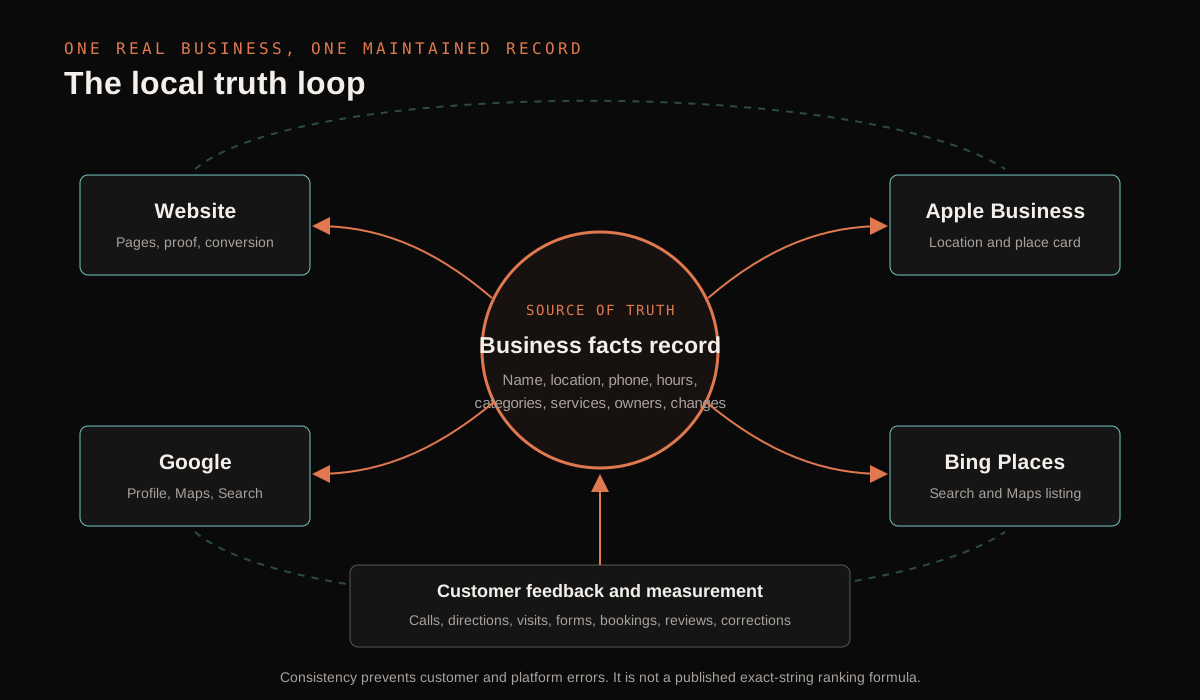
This record is not public schema by itself. It is the internal source that lets the profile, website, customer support, and other platforms tell the same truthful story.
Consistency is error prevention
Name, address, and phone consistency still matters because conflicting public information can mislead customers and platforms. The safe claim is operational: reduce ambiguity, correct important wrong listings, and keep major profiles aligned.
The unsafe claim is that exact punctuation or a fixed number of matching citations has a documented, universal ranking weight. Google says it uses multiple information sources. It does not publish an exact-string NAP scoring formula.
Operate the Google Business Profile
A Business Profile is an ongoing customer-information system. Treat it like a product surface with an owner, update process, and quality checks.
1. Claim, verify, and secure ownership
Verification tells Google that the account is authorized to represent the business. Keep the primary owner under business control, review managers, remove former agencies or employees when appropriate, and document recovery access.
Do not create a duplicate when an existing profile is unclaimed or controlled by someone else. Use the documented ownership and recovery process.
2. Use the real-world name
Enter the name customers see in the real world. Put the address, hours, category, and service details in their dedicated fields. Do not append city names, service lists, slogans, phone numbers, or “near me” language unless they are genuinely part of the established business name.
3. Select accurate categories
Google recommends using the fewest categories needed to describe the core business, with the most specific accurate option as the primary category. A category should complete “this business is a,” not “this business has a.” Category options vary by market, so document changes rather than copying another business blindly.
4. Complete customer-facing facts
Maintain:
- Regular, seasonal, and special hours.
- Phone and website URL.
- Address or service area, using the correct visibility rule.
- Services, products, menu, appointment, reservation, or ordering paths where eligible.
- Attributes that help customers make a decision.
- A useful description without links, promotions, or keyword lists.
Completeness is not license to fill every field with repeated sales copy. Each field has a distinct job.
5. Add representative media
Use clear, current photos and videos that help a customer recognize the location, team, access, service, product, or outcome. Keep originals, dates, and rights records. Geotagging an image file is not established in Google's published guidance as a Local Pack ranking tactic.
6. Recheck after changes
Profile edits can be accepted, rejected, changed by other sources, or trigger re-verification. Review the live result after important changes. Watch for suggested edits, outdated hours, duplicate profiles, changed categories, broken URLs, and ownership drift.
Build website proof for local intent
The profile can summarize the business. The website should answer the questions that do not fit in a listing: what is offered, who it is for, where it is available, why the business is credible, what it costs when appropriate, and how to take the next step.
Google's people-first content guidance asks whether content provides original information, substantial value, clear expertise, and a satisfying answer. Google also says it has no preferred word count. A useful local page is not defined by reaching 1,500 words.
A strong service page
A strong service page usually includes:
- A direct statement of the service and customer problem.
- Who the service fits and who it does not.
- The real service area or location context.
- Process, constraints, timing, and next step.
- Original proof such as project details, practitioner expertise, equipment, certifications, policies, or results that can be substantiated.
- Clear contact, booking, quote, or visit options.
- Links to relevant location, team, case, policy, and contact pages.
A strong location page
A location page should exist because the location changes what the customer needs to know. Useful differences can include:
- The real address, arrival instructions, parking, transit, entrance, accessibility, and hours.
- Staff, departments, equipment, inventory, or services at that location.
- Location-specific phone, booking path, photos, testimonials where policy permits, and local proof.
- Service boundaries or delivery details.
- Local regulations, climate, property types, event context, or other facts that materially affect the service.
- A clear relationship to a store locator or browseable location hierarchy.
The city-name swap test
Replace the city name on a draft location page with another city.
If the page remains substantially true, it probably lacks local value. Adding a map embed, weather paragraph, or list of nearby landmarks does not repair an interchangeable page.
Google's spam policies define doorway abuse to include multiple region or city pages that funnel users to one destination, and substantially similar pages placed closer to search results than a clear browseable hierarchy. This does not make every location page spam. It makes usefulness and distinct operations the deciding tests.
| Useful location page | Thin city-swap page |
|---|---|
| Represents a real location or genuinely different service context | Exists mainly to capture a city query |
| Contains operationally unique facts | Repeats the same template with a changed city token |
| Helps a customer visit, compare, book, or understand delivery | Funnels every visitor to the same generic page |
| Fits a store locator or clear location hierarchy | Sits as a disconnected keyword landing page |
| Is reviewed when the location changes | Is generated at scale without local ownership |
Internal linking that reflects the business
Link from service pages to relevant locations, and from location pages to services actually offered there. Use descriptive anchor text. Make the store locator and location hierarchy crawlable. Avoid a giant footer list of every city merely to repeat keywords.
Create a compliant review system
Reviews are both customer feedback and public evidence. The safest system asks broadly, neutrally, and consistently after a genuine experience.
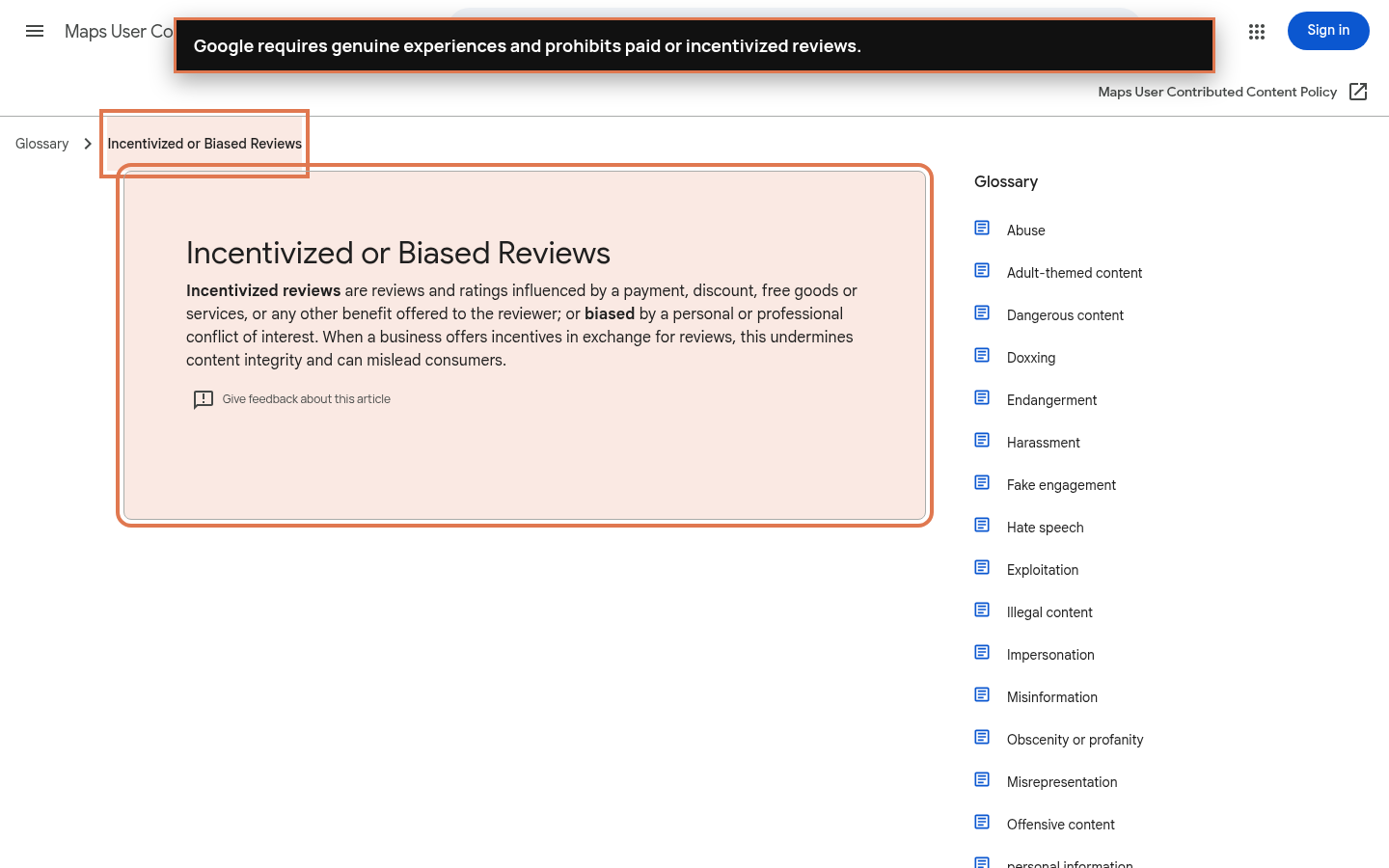
Google lets businesses create a review link or QR code and suggests using it in receipts, thank-you emails, chat, or in-store materials. The same page says offering incentives for reviews is prohibited. Google's Maps prohibited and restricted content policy also prohibits fake engagement, conflicts of interest, selectively soliciting positive reviews, discouraging negative reviews, and pressuring people to provide a specific rating or wording.
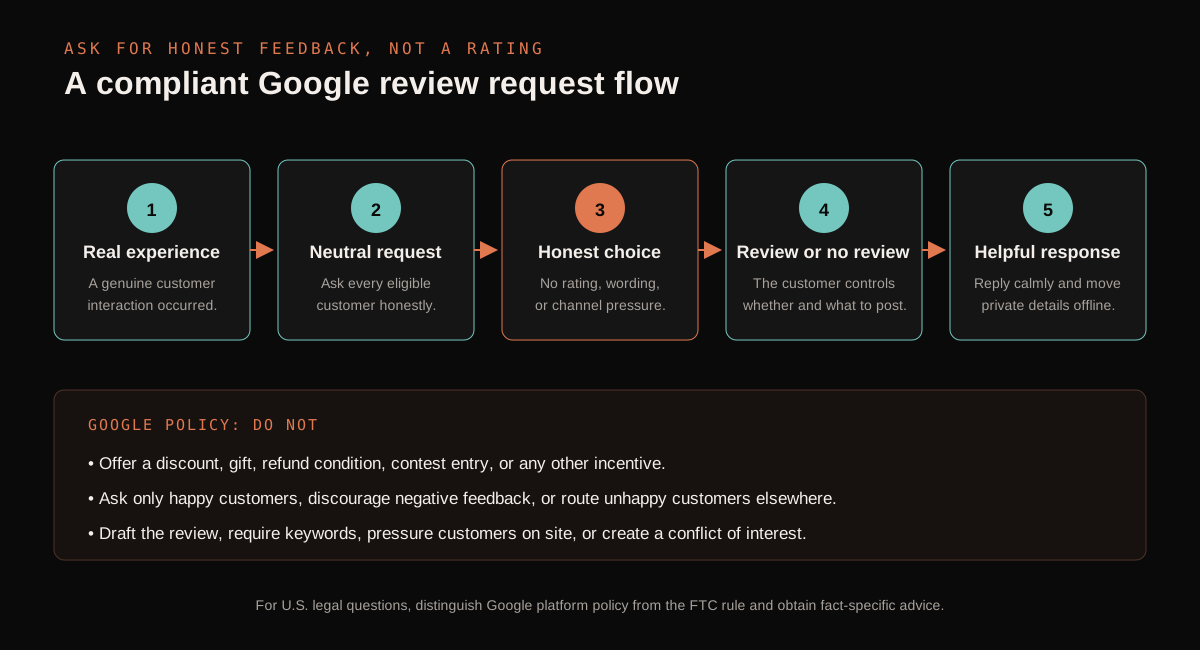
A safe review workflow
- Confirm a genuine customer experience occurred.
- Send one neutral request through an appropriate channel.
- Ask for honest feedback, not a five-star rating.
- Offer no discount, gift, contest entry, refund condition, or other incentive.
- Send every eligible customer to the same review choice. Do not screen by satisfaction.
- Do not draft the review or require particular keywords.
- Record the request source and opt-out behavior.
- Respond helpfully, protect personal information, and move sensitive resolution offline.
- Report a review only when it appears to violate policy, not because it is negative.
Google policy and U.S. review law are not identical
For U.S. businesses, the FTC's Consumer Reviews and Testimonials Rule took effect on October 21, 2024. It addresses fake or false reviews, sentiment-conditioned incentives, certain undisclosed insider reviews, fake independent review sites, review suppression, and threats.
The FTC's Q&A describes circumstances where an incentive not conditioned on positive or negative sentiment may be treated differently under federal law. Google is stricter on its platform: it prohibits incentives for Google reviews. The operational rule is simple. Follow the stricter applicable platform rule for the platform, and get legal advice for a fact-specific compliance question.
This section is general information, not legal advice. See the FTC Q&A and the final rule.
Respond for the customer, not for a keyword theory
Replying shows attention and can help prospective customers understand how the business handles feedback. Keep replies specific, calm, and privacy-safe. Do not force service and city keywords into every response. Google recommends helpful replies, but does not publish keyword-rich replies as a ranking tactic.
Earn prominence without citation folklore
Prominence work should make the business more genuinely known, not simply produce a count of low-value links or listings.
Prioritize references that make sense offline
Good opportunities can come from:
- Local newsworthy work, research, openings, events, or public data.
- Trade associations, chambers, professional bodies, and regulated directories.
- Suppliers, venues, institutions, schools, charities, and community partners.
- Expert contributions to relevant local or industry publications.
- Sponsorships chosen for business or community value, with links treated appropriately.
- Original guides, tools, data, or case material worth referencing.
Google's spam policies prohibit buying or exchanging links for ranking purposes, automated link creation, low-quality directory links, and excessive reciprocal schemes. Paid sponsorship can be normal, but links should be qualified appropriately.
Repair important listings, do not chase a magic number
Audit the profiles customers and platforms are likely to use:
- Google Business Profile.
- Apple Business.
- Bing Places.
- Major industry or regulatory sources.
- Important local directories and publishers.
- Navigation, delivery, reservation, insurance, healthcare, legal, or marketplace systems relevant to the business.
Correct high-impact errors first: wrong phone, closed location, duplicate record, bad route, outdated hours, or incorrect category. A tiny punctuation difference is rarely more urgent than a customer reaching the wrong place.
Maintain Apple Business and Bing Places
Google is not the only first-party business listing surface.
Apple replaced Apple Business Connect with Apple Business in April 2026 and migrated existing information. Businesses can claim and manage locations and place-card information, subject to product and regional availability. Use the current Apple Business announcement and location guidance, not older setup articles that still use the retired product name.
Microsoft introduced a rebuilt Bing Places for Business portal in October 2025 for managing Search and Maps listings, including imports and bulk tools. Its announcement discussed future integrations, so do not present every roadmap item as shipped. See the Bing announcement.
Maintain these platforms from the same business-facts record:
- Claim and verify the real entity where available.
- Use the correct location name, address visibility, phone, URL, category, and hours.
- Review customer-facing media and actions.
- Recheck after a move, rebrand, phone change, seasonal schedule, merger, or closure.
- Record regional limitations instead of treating an unavailable feature as an error.
The benefit is accurate discovery and fewer customer mistakes across important ecosystems. Do not turn platform maintenance into an unsupported promise about a specific ranking lift or AI answer.
Use LocalBusiness schema honestly
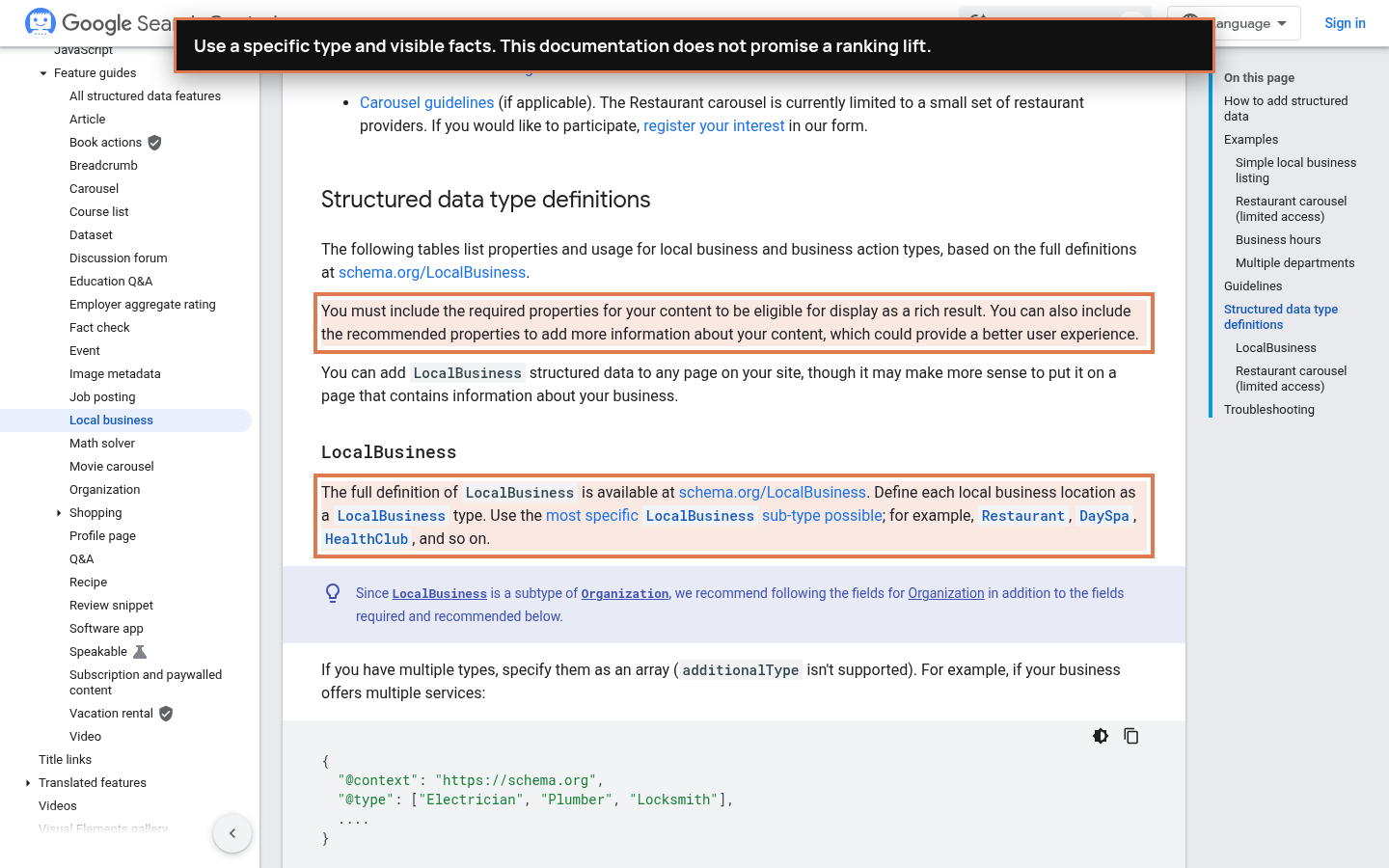
Structured data makes visible page facts machine-readable. Google's LocalBusiness documentation recommends the most specific applicable subtype and documents fields such as name, address, telephone, opening hours, and geo coordinates.
What to mark up
Use JSON-LD that matches what a visitor can verify on the page:
{
  "@context": "https://schema.org",
  "@type": "Dentist",
  "@id": "https://example.com/locations/central#business",
  "name": "Example Dental",
  "url": "https://example.com/locations/central",
  "telephone": "+1-555-0100",
  "address": {
    "@type": "PostalAddress",
    "streetAddress": "10 Example Street",
    "addressLocality": "Example City",
    "postalCode": "10000",
    "addressCountry": "US"
  }
}
The example uses fictional data. Google's documentation supports accurate subtype selection, visible-data parity, crawlability, and validation. Stable @id values and organization relationships are practitioner implementation patterns, not requirements that Google lists for LocalBusiness rich-result eligibility. In production:
- Choose the most specific accurate subtype.
- Give each location a stable, unique
@id. - Match visible name, address, phone, hours, and URL.
- Connect the location to the organization when appropriate.
- Keep the page crawlable and validate the markup.
- Remove stale properties when the visible business facts change.
Google's LocalBusiness rich-result documentation lists a physical address as required for that documented result type. If a service-area business must hide its address from customers, do not expose a private home address in markup merely to satisfy that requirement. Keep schema aligned with the visible page and accept that the page may not qualify for that particular rich-result path.
What schema cannot promise
Valid structured data does not guarantee a rich result, a Map Pack position, a ranking increase, or an AI citation. Google's general policies explicitly say correct markup does not guarantee display.
Be especially careful with reviews. Google's review snippet documentation says self-controlled reviews for LocalBusiness and Organization are not eligible for Google's review star feature. Do not copy customer ratings into aggregateRating merely to chase stars.
Measure business outcomes
The objective is not a green audit score or a single map screenshot. It is more qualified discovery and more valuable customer action at an acceptable cost.
Build a measurement stack
| Layer | Useful measures | Important limitation |
|---|---|---|
| Business Profile performance | Views, searches, direction requests, call-button clicks, website clicks, bookings where available | Verified profiles only. Calls are clicks, not answered calls. Google says the report can include organic results and Google Ads, so it is not organic-only. Search terms can lag. |
| Search Console | Queries, pages, clicks, impressions, click-through rate, device, country, trend | Some queries are anonymized. City-level query reporting is not provided. Local Pack behavior is not fully represented. |
| Web analytics | Landing sessions, engaged visits, forms, booking starts, completed bookings, phone-link clicks | Consent, attribution, cross-device behavior, and blocked scripts affect completeness. |
| Call and booking systems | Connected calls, qualified calls, appointments, cancellations, revenue | Tracking configuration can change displayed numbers or attribution. Maintain profile accuracy. |
| Rank grid | Geographic variation for a defined query and time | Diagnostic snapshot, not traffic, leads, revenue, or a stable universal position. |
| CRM or sales record | Qualified lead, opportunity, sale, revenue, repeat value | Requires disciplined source capture and privacy-safe handling. |
Use campaign parameters carefully
Add consistent UTM parameters to website links from managed profiles when the platform permits them. Document the naming convention, keep the customer destination clean, and make sure redirects preserve the parameters. This helps distinguish listing traffic in analytics. It does not change rankings.
Compare trends, not isolated points
Use weekly and monthly comparisons that account for seasonality, business changes, promotions, outages, and Ads. Annotate major profile edits, review campaigns, page launches, relocations, tracking changes, and algorithm volatility.
A useful monthly review asks:
- Did qualified discovery increase or decrease?
- Which locations, services, queries, and devices changed?
- Did customer actions change in the same direction?
- Did lead quality, booking rate, or revenue change?
- What operational or tracking change could explain the movement?
- What single improvement or test should happen next?
Follow a 30, 60, and 90 day plan
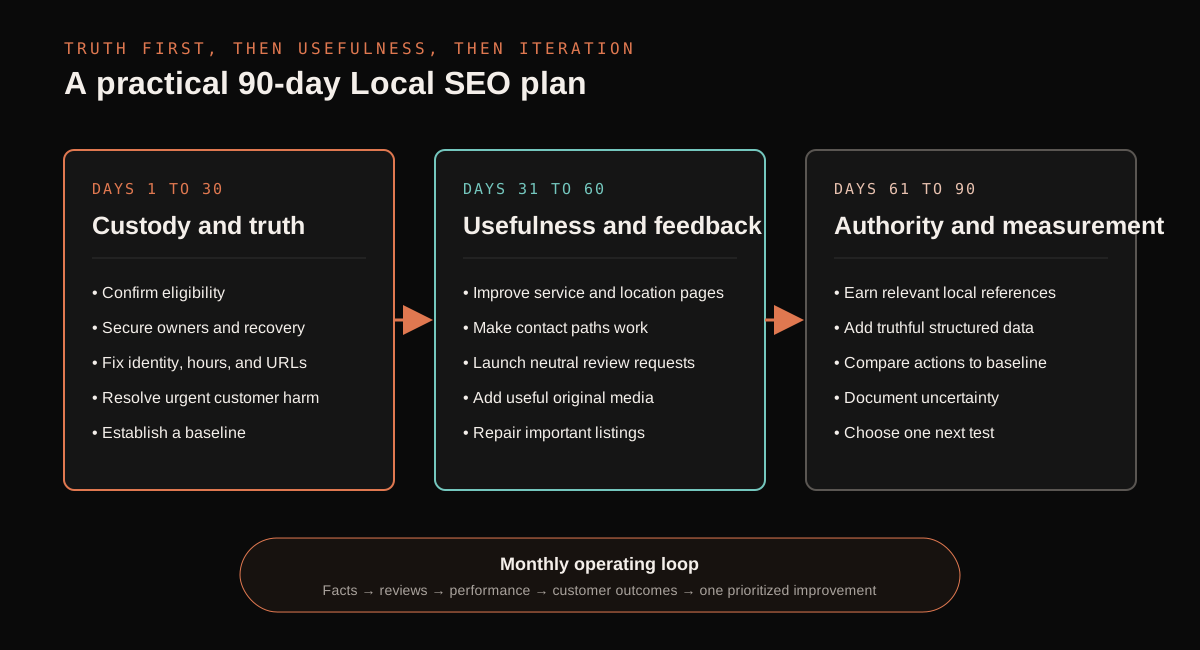
Days 1 to 30: custody, eligibility, and truth
- Confirm the real business model and profile eligibility.
- Resolve primary ownership, manager access, and recovery contacts.
- Find duplicates and document the intended canonical profile for each location.
- Create the business-facts record.
- Correct the real-world name, address or service-area treatment, phone, URL, categories, and hours.
- Configure special-hours ownership and review dates.
- Set up analytics, Search Console, conversions, call or booking measurement where appropriate.
- Export a baseline of profile performance, landing-page performance, leads, and rank-grid diagnostics if available.
- Fix urgent customer harm first: wrong route, wrong number, closed location, broken booking path, or ineligible address.
Days 31 to 60: usefulness and feedback
- Improve the highest-value service and location pages.
- Run the city-name swap test on every location template.
- Strengthen contact, booking, quote, and visit instructions.
- Add current, rights-cleared photos that help a customer decide or arrive.
- Launch a neutral review request workflow using Google's link or QR code.
- Create a response playbook for positive, negative, and policy-violating reviews.
- Claim or refresh Apple Business, Bing Places, and the highest-impact industry profiles.
- Repair important duplicate or inaccurate listings.
Days 61 to 90: authority and operating cadence
- Build one or two relevant local authority initiatives based on real work, partnerships, events, or original resources.
- Add the appropriate Organization or LocalBusiness structured data where it matches the business model, public facts, and visible page.
- As an implementation pattern, validate stable
@idvalues, organization relationships, and page parity where they are used. - Review profile and website changes against the baseline.
- Segment leads and conversions by location and service where possible.
- Document which improvements were shipped, what moved, and what remains uncertain.
- Establish a monthly facts, reviews, performance, and ownership review.
- Choose the next test based on customer value, not on the easiest vanity metric.
Do not do everything at once
If ownership is broken, fix ownership. If the phone is wrong, fix the phone. If a location is ineligible, stop expanding it. If the website cannot convert, improve the page before buying another rank tracker.
The order reduces risk because each layer makes the next layer easier to interpret.
Separate myths from evidence
| Claim | Evidence verdict | Better action |
|---|---|---|
| Add service and city keywords to the Business Profile name | Conflicts with Google's real-world-name policy | Use the established name and complete the dedicated fields and pages |
| Post on the Business Profile every day to rank higher | No confirmed universal ranking cadence | Post useful, current information when it serves customers |
| Geotag every photo for a Maps boost | Not supported by reviewed Google guidance | Publish clear, representative, rights-cleared media |
| Put keywords in every review reply | Not documented as a ranking tactic | Reply naturally and helpfully for customers |
| Embed a Google Map to rank in the Local Pack | No confirmed direct ranking effect | Add a map when it genuinely helps visitors find the location |
| Match NAP punctuation everywhere | Overstated as a direct factor | Correct material identity errors and keep major sources accurate |
| Build a fixed number of citations | No universal count published | Prioritize important platforms, industry sources, and customer harm |
| Add schema to improve Map Pack ranking | Structured data is not a published ranking guarantee | Mark up visible facts accurately and validate |
| Publish a page for every nearby city | Can create doorway and scaled-content risk | Publish only where distinct local value or operations justify the page |
| Buy or incentivize reviews | Prohibited by Google and can create legal risk | Ask all eligible customers neutrally, without incentives or gating |
| A rank-grid score proves revenue impact | Diagnostic only | Connect visibility to calls, bookings, qualified leads, and revenue |
The absence of a confirmed ranking effect does not make every tactic useless. A map can help a visitor. A post can announce a closure. Consistent formatting can reduce support errors. The correction is to state the customer benefit honestly instead of turning every feature into a ranking claim.
Audit the system with Claude SEO
Once the operating foundations are clear, the Claude SEO Local SEO skill can inspect observable signals across a target page, profile checklist, reviews, local pages, business information, citations, structured data, and local authority.
/seo local https://your-business.com
The skill detects storefront, service-area, or hybrid patterns and produces a prioritized Local SEO analysis. Its six-dimension weighting is an internal audit framework, not Google's ranking formula. Without connected data, it cannot infer live Map Pack position, private profile analytics, comprehensive backlinks, or the causal reason a ranking changed. Unretrievable facts should stay marked unverified.
Use it as a structured second set of eyes:
- Find missing or conflicting observable facts.
- Surface policy and manual-review questions.
- Compare location-page structure and visible schema.
- Organize actions by impact and effort.
- Record which findings require owner, platform, analytics, or legal verification.
The audit is most useful when it sits on top of a maintained facts record and real business data. It should not replace profile ownership, customer research, human review, or measurement.
Claude Code Local SEO: Rank Any Business on Google Maps
Daniel Agrici demonstrates the Local SEO Brain workflow, its memory structure, live audit flow, API layer, and Claude SEO integration.