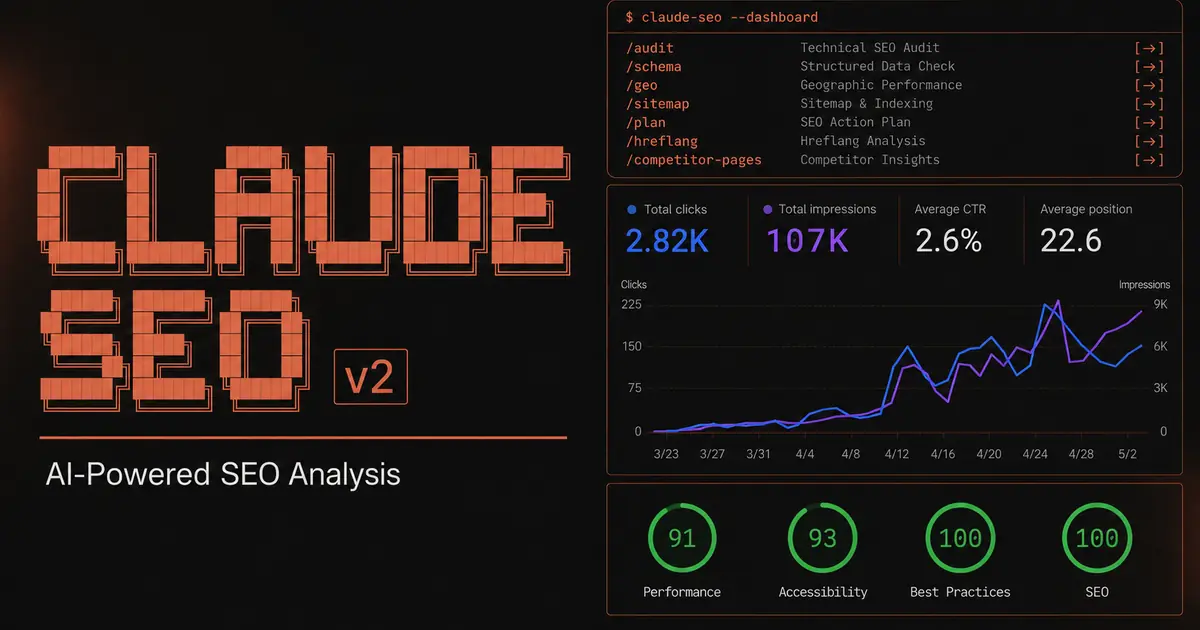
- Biggest release yet: 25 sub-skills, 18 agents, and a test suite grown from 39 to 247. Free, open-source, MIT licensed.
- Security-hardened crawling: every web request runs through a shared SSRF-safe layer, and fetched pages are fenced as data, not instructions. The reading agent has no shell.
- Built for AI search: question-based citability scoring, an llms.txt evidence reframe, and four new Schema.org generators.
- QRG-aligned content gates: a scorer for filler and AI-pattern density, a 40-plus phrase humanizer, and claim verification before you publish.
- Deeper Core Web Vitals: LCP subparts from real CrUX field data, Speculation Rules and bfcache checks, and IndexNow submission.
What's new in Claude SEO v2.0.0?
Claude SEO v2.0.0 is the biggest release since the project launched. It hardens every web request against prompt injection, adds a layer of AI-search optimization built on how AI engines actually choose sources, and grows the automated test suite from 39 cases to 247. It is still free and still MIT licensed.
The headline number is the test count. Going from 39 to 247 tests is not a vanity metric. It is the difference between a tool you hope works and a tool whose security and correctness claims are checked on every commit. The rest of the release sits on top of that foundation.
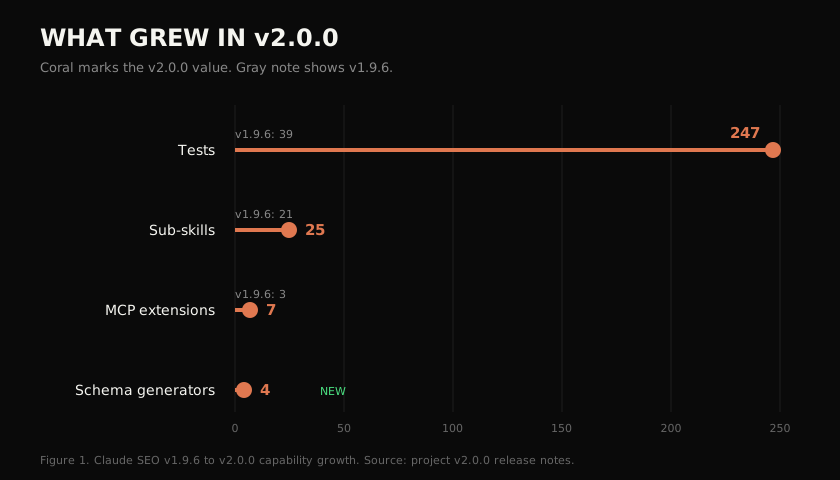
At a glance: five new MCP extensions (Ahrefs, SE Ranking, Profound, Bing Webmaster, Unlighthouse), a shared headless renderer used by every fetching agent, AI Share-of-Voice tracking, parasite-SEO risk scanning, and multi-platform portability so the same workflow runs in Codex, Cline, and Aider. If you are coming from v1.9.6, the jump is large enough that I wrote this post to walk through the parts that change how you work.
Why does an SEO tool need security hardening?
An SEO tool reads the open web on your behalf, and that makes it a target. v2.0.0 routes every fetch through a shared SSRF-safe layer and treats the page it pulls back as untrusted data rather than as instructions. The agent that reads a competitor's HTML cannot run a shell command, so an injected instruction has nothing to execute.
This matters more than it did a year ago. Google's security team now treats indirect prompt injection as a defining risk for AI systems that browse the web, because a malicious page can hide instructions that hijack the model reading it. An SEO crawler is exactly that surface: it fetches pages you do not control and feeds them to a model.
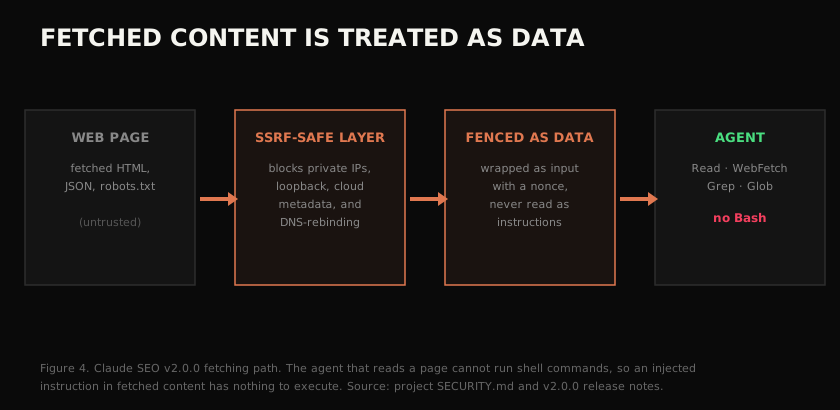
The SSRF-safe layer (url_safety.py) blocks private IP ranges, loopback, cloud metadata endpoints, and DNS-rebinding via the redirect target. The content that survives the network check is then wrapped with a per-request nonce so the model can tell where your data ends and a page's text begins. The agents that read those pages are scoped to read-only tools, nothing more. Defense in depth, not a single check. The full threat model lives in the project's SECURITY.md, and it pairs naturally with the crawl-safety work in the technical SEO guide.
How is v2.0.0 built for AI search?
AI search is no longer a side channel. Google's AI Overviews reached two billion monthly users in 2025, the company reported on its Q2 earnings call. When one of those summaries appears, the click economics change underneath you.
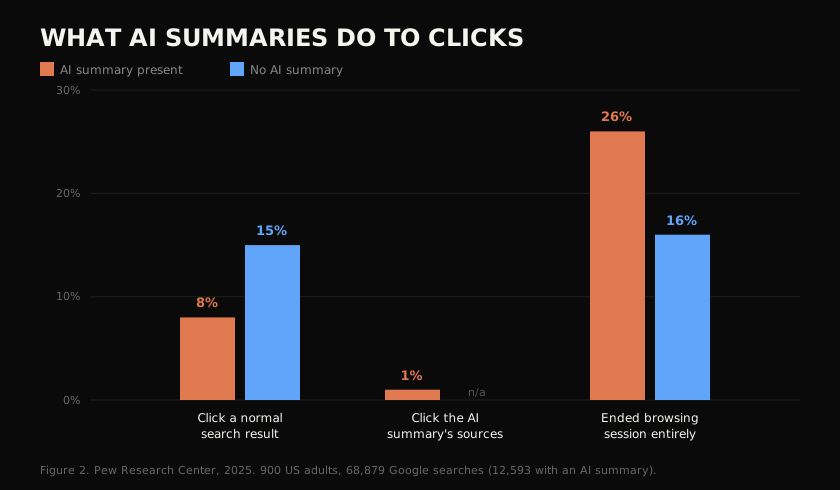
Pew Research Center tracked 68,879 Google searches across 900 US adults in 2025. When an AI summary showed up, users clicked a normal search result on 8 percent of visits, down from 15 percent without one. Just 1 percent clicked a link inside the AI summary itself. People also ended their session more often, 26 percent versus 16 percent.
So how do you become the cited source? The strongest evidence is not about tricks. A peer-reviewed study from Princeton and collaborators, presented at KDD 2024, tested optimization tactics across 10,000 queries. It found that adding statistics, citations, and direct quotations lifted a source's visibility in generative-engine answers by up to 40 percent. Clear, evidence-dense, well-attributed writing wins.
What does not appear to win is gaming a file. Google's John Mueller has said no major AI service uses llms.txt, comparing it to the long-ignored keywords meta tag. Industry voices have made the same case about the wider trend, with one telling Digiday that "80 percent of GEO is good, fundamental SEO." v2.0.0 takes that honestly. Its AI-search layer scores pages for question-based citability and reframes llms.txt as an evidence signal rather than a ranking lever. If you want the full method, the GEO guide and the evidence-led FLOW framework go deeper.
Content Quality Gates Aligned to Google's Rater Guidelines
Google's March 2024 core update set out to reduce low-quality, unoriginal content in results by about 40 percent, per its own Search Central announcement. v2.0.0 added internal content gates that surface related quality risks for human review before publication.
Three scripts do the work. A content-quality scorer flags filler, repetitive language, and unnatural keyword use. A humanizer reviews more than 40 phrases that can make prose feel generic or over-polished, without claiming to detect authorship. A claim-verification pass checks that statistics trace back to a named source. Together they organize review around the Experience, Expertise, Authoritativeness, and Trustworthiness concepts described in the Quality Rater Guidelines.
Core Web Vitals, in Depth
The performance bar keeps rising. The 2025 Web Almanac reported that about 77 percent of mobile pages achieved a good Interaction to Next Paint score under 200 milliseconds in its dataset. The same edition reported that fewer than half of origins passed all three Core Web Vitals. These are dated ecosystem observations, not targets for an individual site.
v2.0.0 stops treating Core Web Vitals as a single score. It pulls LCP subparts from real CrUX field data so you can see whether your largest paint is slow because of server response, resource load, or render delay. It audits Speculation Rules, back-forward cache eligibility, and prerender hints. It can also submit changed URLs through IndexNow so fixes get recrawled faster. The deeper technical checks are covered in the technical SEO walkthrough.
How Claude SEO v2.0.0 Compares
Claude SEO is free, open-source, and runs inside the terminal you already use. Ahrefs and Semrush use paid subscription models, while Claude SEO has no paid product tier. Optional data providers and Claude Code can still have their own costs. Check each vendor's current pricing page before making a purchase decision.
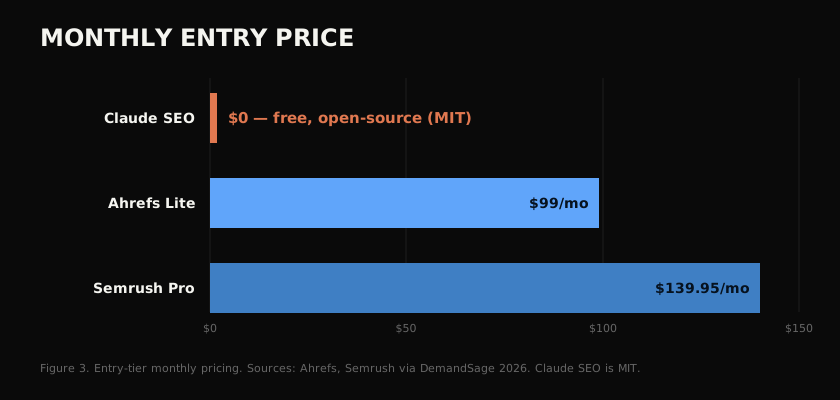
Breadth is the other half of the story. A lot of SEO skills do one thing well. Claude SEO v2.0.0 covers the full surface in a single install:
| Area | What v2.0.0 covers |
|---|---|
| Technical SEO | Crawlability, indexability, Core Web Vitals with LCP subparts, Speculation Rules, IndexNow |
| Content and E-E-A-T | Quality scoring, humanizer, claim verification, QRG alignment |
| Schema | Detection, validation, and four new JSON-LD generators |
| AI search (GEO) | Citability scoring, llms.txt evidence reframe, AI Share-of-Voice tracking |
| Local and Maps | GBP, NAP, citations, reviews, geo-grid rank tracking |
| E-commerce and International | Product schema, marketplace data, hreflang with cultural profiles |
| Backlinks | Free tier via Moz, Bing, and Common Crawl, paid via DataForSEO |
The honest caveat: Claude SEO is weakest at live rank tracking and keyword volume, which is exactly where Ahrefs and Semrush are strongest. That is why the optional Google API and DataForSEO extensions exist. For most teams the answer is not either-or. The full breakdown lives in the Claude SEO vs Ahrefs and Semrush comparison.
How to Install the Claude SEO Skill for Claude Code
Two commands. One adds the marketplace, one installs the plugin.
/plugin marketplace add AgriciDaniel/claude-seo
/plugin install claude-seo@agricidaniel-claude-seo
Prefer to inspect the code first? Clone the repository and run the installer, which is the approach I recommend over piping a script straight into your shell:
git clone --depth 1 https://github.com/AgriciDaniel/claude-seo.git
bash claude-seo/install.sh
Both paths install v2.0.0. Here is the two-minute release walkthrough if you would rather watch than read:
25 sub-skills. 18 agents. 247 tests. MIT licensed, free forever. Once installed, run /seo audit https://yourdomain.com to spin up the parallel audit, or jump straight to /seo geo https://yourdomain.com to score a page for AI citability.