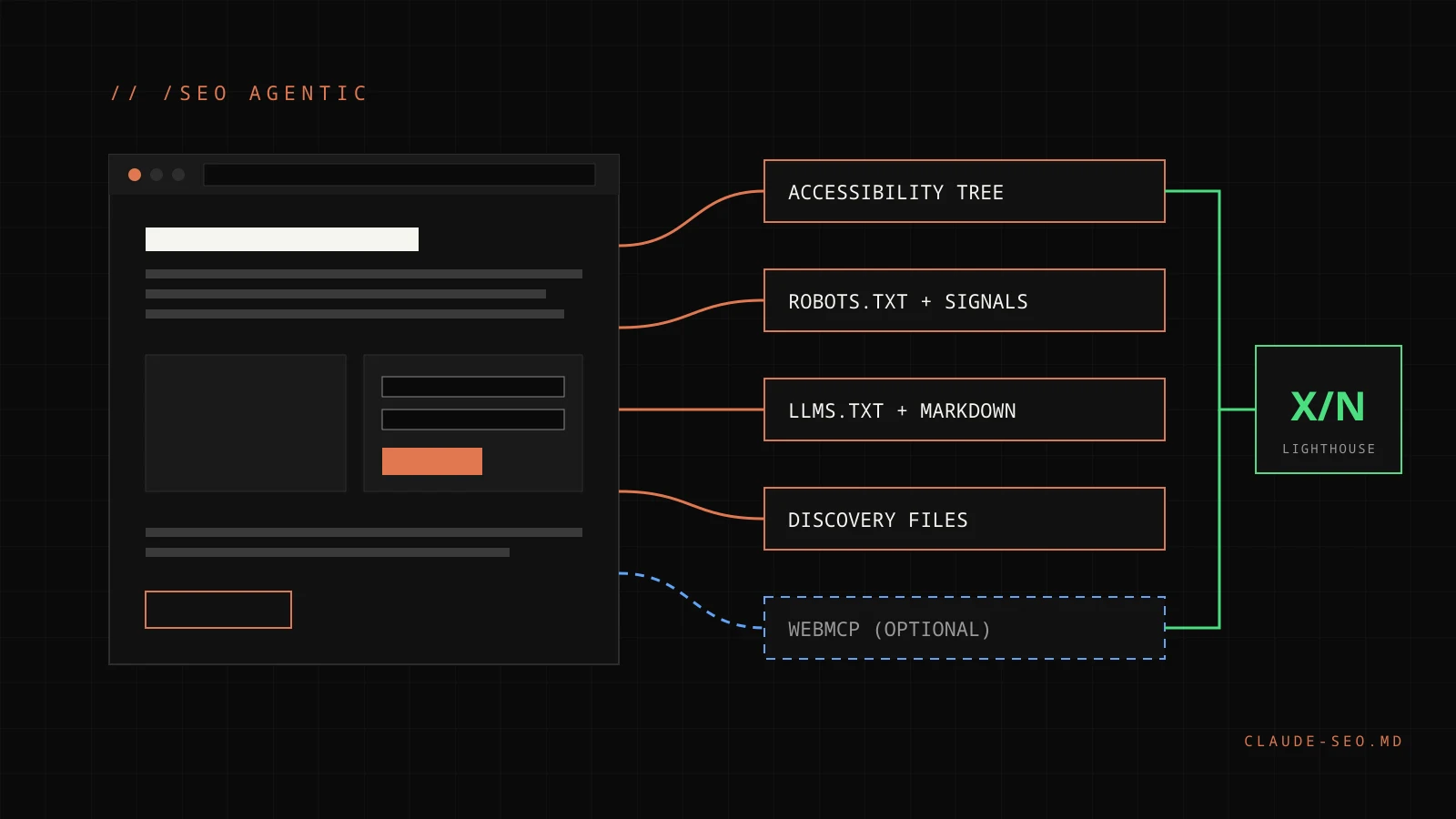
The skill starts from one framing: agent readiness is accessibility plus performance plus access policy, with a Markdown and discovery layer on top. WebMCP is an optional enhancement for sites with forms or transactions, not a foundation. The audit runs its checks in a fixed order and keeps each tool's JSON for the report.
- Lighthouse fraction.
lighthouse_agentic.pyreads the Agentic Browsing category through PageSpeed Insights v5 or a saved report and reproduces the Lighthouse report renderer's fraction exactly. - HTTP and markup checks.
agentic_check.pycovers server-rendered content, robots.txt groups per AI agent and Content-Signal, llms.txt, Markdown delivery, ai-catalog.json,/.well-knowndocuments, WebMCP markup, and whether unknown URLs return a real 404. - Accessibility tree.
agent_ux_check.pyproduces a local 0 to 100 heuristic, presented separately from the Lighthouse fraction. - WAF behaviour, only with authorization. The
--ua-matrixoption reports how the site treats unverified traffic carrying AI agent user agents. It is never treated as proof that the real agent is blocked. - Commerce handoff. On e-commerce sites a UCP profile is flagged and the depth goes to the e-commerce skill.
In a full site audit, the orchestrator now spawns the seo-agentic agent alongside seo-geo, and its findings feed the AI Search Readiness category.
Primary sources: the seo-agentic skill file, the seo-agentic agent file, and the v2.4.0 release notes.