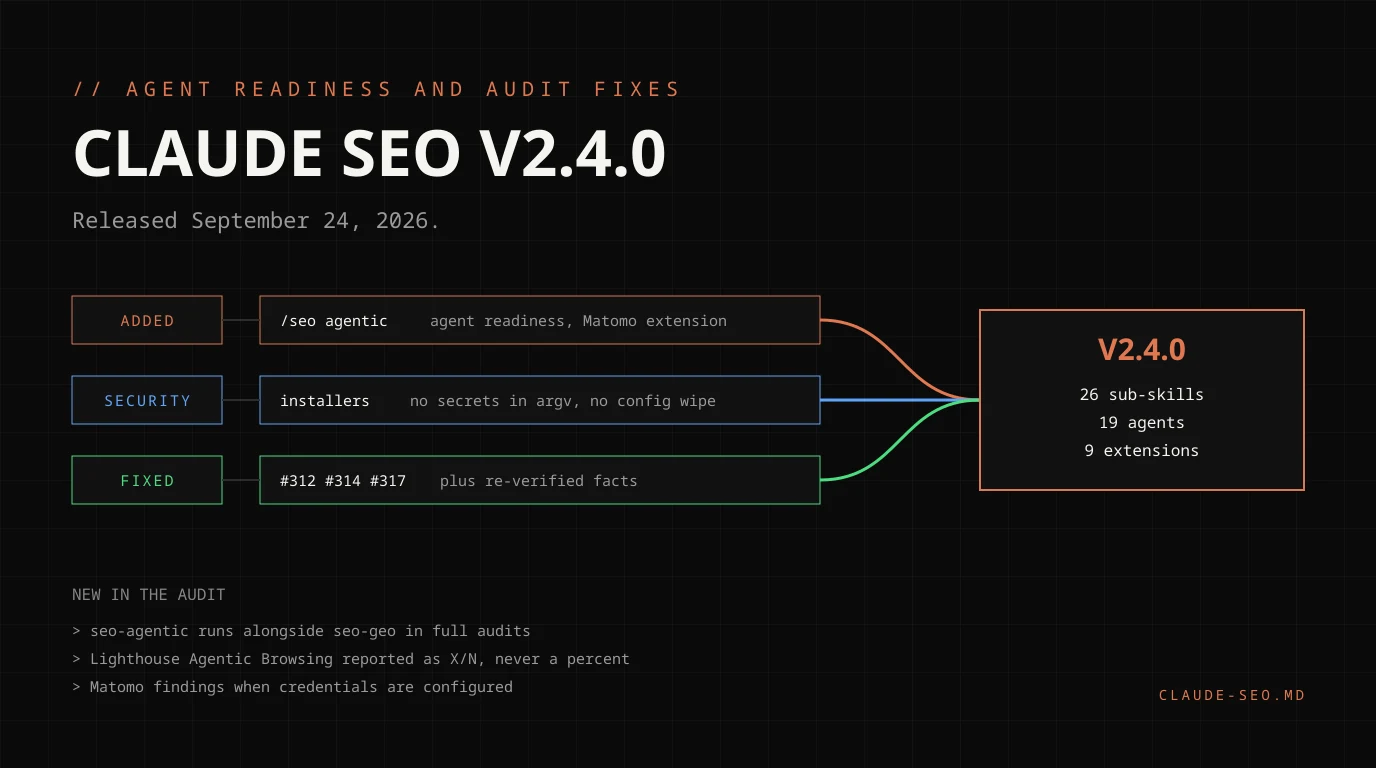
Claude SEO v2.4.0 is a minor release dated in the project changelog. GitHub records the release as published at 22:22 UTC on September 23, 2026, and the tag resolves to commit e77e783. It follows v2.3.1.
In short: the new /seo agentic command scores Lighthouse's Agentic Browsing category exactly as Lighthouse counts it and audits the rest of agent readiness. A new optional Matomo extension adds self-hosted analytics. Extension installers no longer pass secrets on the command line or reset a malformed ~/.claude.json. Issues #312, #314 and #317 are fixed.
Watch the /seo agentic walkthrough
The four minute video below shows why agent readiness matters and what /seo agentic does: it runs the same Agentic Browsing check Lighthouse runs, audits everything around it, and drafts the fixes. In the video, a normal site passes 1 of 2 counted audits, while claude-seo.md scores 6/6.
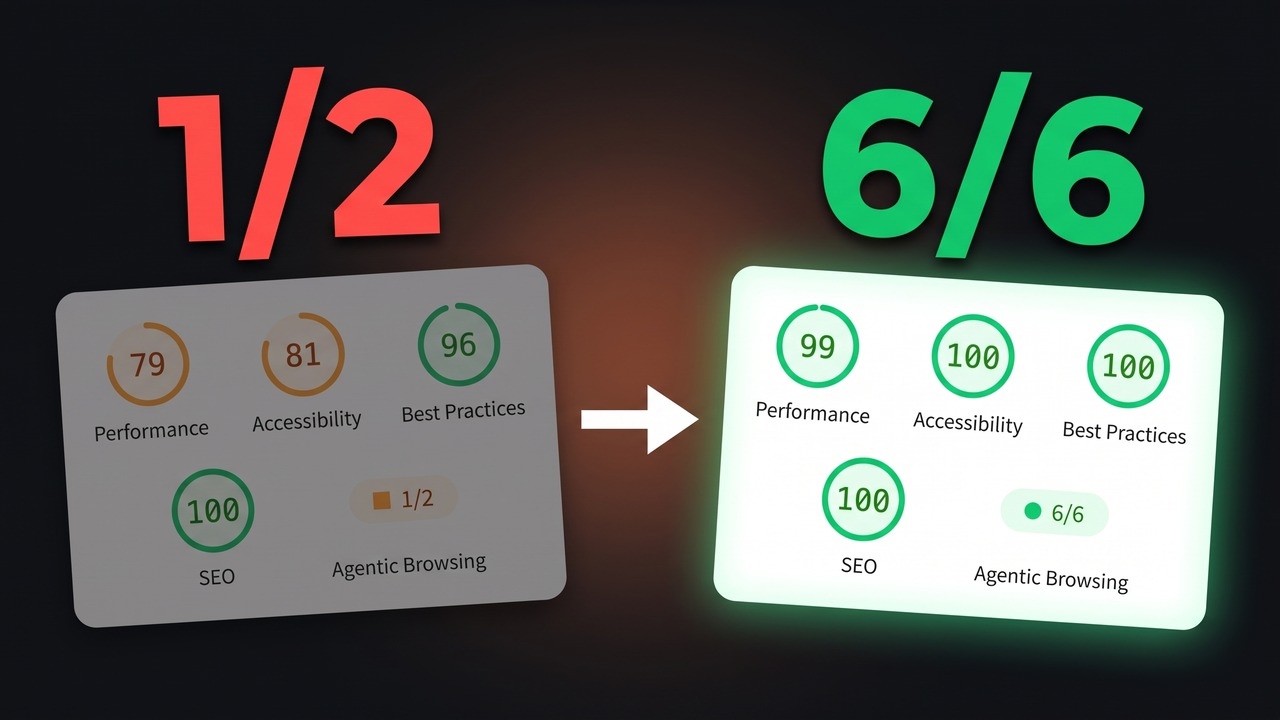
my 17.5k-star Claude-seo skill now audits AI agent readiness. Published September 23, 2026. Runtime 4:10. Watch on YouTube.
What does /seo agentic add?
The new agent readiness skill and its seo-agentic audit agent answer one question: how well can AI agents that browse and act for people read and use a site? The command takes four forms: /seo agentic <url> for the full audit, plus lighthouse, fix and refresh modes. Three scripts do the work:
lighthouse_agentic.pyreads the Agentic Browsing category through PageSpeed Insights v5 or a saved report and reproduces the report renderer's fraction exactly: not-applicable, manual and informative audits are excluded, and a counted audit passes at a score of 0.9. It lists each audit's status and the changes that would add a counted audit.agentic_check.pychecks server rendering, RFC 9309 robots.txt group selection per AI agent and Content-Signal, llms.txt with Lighthouse parity, Markdown delivery,ai-catalog.jsondiscovery and ARD conformance,/.well-knowndocuments, WebMCP markup, and, only with--ua-matrix, responses to AI agent user agents. It also adds anhttp-404check, because a host that answers unknown paths with 200 fails two Lighthouse audits.agentic_fix.pydrafts Content-Signal lines for every robots.txt group without touching Allow or Disallow, plus llms.txt,ai-catalog.json, and WebMCP tools bound to each form's own submit handler.
Every request goes through url_safety. The release notes say the facts behind the skill were verified on September 23, 2026 against the Lighthouse 13.5.0 source, live PageSpeed Insights runs, the WebMCP spec draft and vendor bot documentation, with a dated, source-graded vendor matrix in one reference file. Full audits now spawn seo-agentic alongside seo-geo and write findings/agentic.md. The page guidance that used to live in seo-technical moved to this skill and was rewritten for Lighthouse 13.5.0, whose category has seven audits rather than three accessibility checks.
If you are weighing WebMCP itself, the WebMCP fit check covers when a pilot is worth building.
What does the Matomo extension do?
The optional extension in extensions/matomo/ supports self-hosted Matomo or Matomo Cloud and adds /seo matomo organic, top-pages, device, country, referrers and keywords as an alternative or complement to GA4. When the credential check succeeds, the audit orchestrator spawns a seo-matomo agent that writes findings/matomo.md. Credentials live in ~/.config/claude-seo/matomo.json, written atomically with mode 0600, and the MATOMO_URL, MATOMO_API_TOKEN and MATOMO_SITE_ID environment variables still take precedence. A self-hosted instance on a private address is reached only when you name it in CLAUDE_SEO_LOCAL_TARGETS, and a redirect away from the instance is refused. Tim J. Peters contributed the extension (#275).
Which security problems were fixed?
- No secrets on the command line. Extension installers that write credentials passed API keys, tokens and passwords to Python as arguments, readable by any local user through
ps. They now travel in the environment, and PowerShell clears the variables afterwards. - No more wiped configuration. Seven shell writers and three PowerShell writers reset
~/.claude.jsonor~/.claude/settings.jsonto{}when the file failed to parse, deleting the whole Claude Code configuration. They now exit with "Nothing was changed". - The Banana setup checks showed the first eight characters of the Google AI key; they now show only the last four. CodeQL found it and is now enabled on the repository.
keywordseverywhere_api.pycould echo the API key in an error; keys are now stripped, checked for control characters, and redacted in every error.
What else was fixed?
- #314: UTF-8 pages served as
text/htmlwithout a charset were decoded as ISO-8859-1 in seven scripts. One decoder now serves every fetch. - #312: the Keywords Everywhere fallback called a removed endpoint. It now uses the bulk domains endpoint with Bearer auth; the release notes say it was verified against the API docs and with an invalid key, but not yet exercised with a valid key.
- #317: skills named DataForSEO tools that the pinned MCP server does not have. A fixture of the pinned server's 80 tool names now guards every skill.
- The Ahrefs and DataForSEO PowerShell installers failed to parse on Windows PowerShell 5.1. Every shipped
.ps1file is now ASCII, and CI parses each extension script on both PowerShell versions. - Cross-skill reference paths are anchored to
${CLAUDE_PLUGIN_ROOT},ucp_check.pyaccepts spec-conformant UCP profiles, and malformed or hostile input that crashed four scripts now produces a finding instead.
Are there breaking changes?
Three, all in machine-readable output or installer behaviour. The keywordseverywhere_api.py output drops page_rank_integer and turns rank into the API's global integer rank. The ucp_check.py output drops parse.merchant and moves endpoints to parse.services. An unparseable settings file now makes an installer exit non-zero instead of overwriting it. Check the release notes if a script of yours parses either output.
What do the counts look like now?
| Item | v2.3.1 | v2.4.0 |
|---|---|---|
| Sub-skills | 25 | 26 |
| Specialist agents | 18 | 19 |
| Extensions | 8 | 9 |
| User-invocable commands (README table) | 32 | 34 |
| Parallel audit agents, at most | 15 | 17 |
The release notes state 26 sub-skills, 19 sub-agents, 60 scripts and up to 17 parallel audit agents, corrected to what is on disk. The v2.3.1 column and the command counts come from the repository at each tag. The release also re-verified a set of skill facts against primary sources on September 23, 2026, raised several dependency floors, and removed a deprecated PDF reference that nothing loaded.
How do I update to v2.4.0?
Reinstall through the plugin marketplace, or run the installer pinned to the tag, then check the runtime. The installation guide covers Windows and manual installs.
curl -fsSL https://raw.githubusercontent.com/AgriciDaniel/claude-seo/v2.4.0/install.sh | bash
/seo setup
/seo doctor
/seo agentic https://your-site.com
How was the release checked?
According to the release notes, v2.4.0 went through two independent audits, a verification pass and a random-input fuzz, and the test suite passes at every commit. The notes do not give a test count, so this post does not state one.
On September 24, 2026 the repository had 17,547 stars and 2,572 forks.
Official source: Read the Claude SEO v2.4.0 release for the canonical summary and tag.